Showing posts with label Puppy Culture. Show all posts

Tuesday, May 5, 2020

And then there were NONE!


And then there were NONE! Last but not least, Bradley/Orange Boy 🧡 is now "Briggs"! This cool little dude had zero issues making a 3,300 mile road trip to join Katie and her Vizslas, Landon & Halle in Southampton, NY. Huge thank you to everyone who helped transport this pup from San Diego>>Denver>>Camp Rhapsody, NC>>Southampton. "Briggs" is named after "Sky Briggs" a character in the James Bond movie "GoldenEye 007" and the name is a nod to his Great-Grandfather "JB" (https://bit.ly/35udY4E) who we all loved and adored. We are looking forward to seeing Briggs in the Show ring, and other Performance events and he will be a service dog for Katie. There were some tears sending off this puppy, but I know I will see him again! Bye bye Briggs, we will miss you! 😘

"Briggs" (Jett/Emery)
Moonlight Reason to Believe

📷 Michelle

Saturday, April 25, 2020

Complete House Training Guide

Ultimate Guide to House-Training Your Puppy, you will learn:

  • How to prevent accidents before they happen
  • How to customize a potty routine appropriate for your puppy's age
  • Tips to teach your dog to potty quickly and reliably as soon as they go outside
  • What to do if your dog has an accident in the house
  • How to teach your dog to potty in a specific area in the yard
  • Ways to recognize when your dog needs to go outside (coming soon)
  • How to teach your dog to tell you when they need to potty (coming soon)

Link to more: https://www.levelupdogtraining.com/puppy-training/puppy-potty-training-planner/?fbclid=IwAR0fKqiOpv41geT5wLiqbrAYHKGwIPjNuOmgYiRpfTWDjCooMCzz6lkR_Ug

Sunday, March 29, 2020

And then there were SEVEN!


And then there were SEVEN! Baker/Blue Boy 💙now "Deacon a/k/a Deeks" joined Adam in Colorado after a whirlwind road trip back and forth from CO to CA in two (2) days! Adam had a puppy from my first litter in 2009 ("Priest" Dallas/Csilla) and it's such a nice compliment when people come back for another. So happy this worked out! We hope to see Deacon in the field one day (and I can't wait to visit them later this summer 🤞).

"Deacon a/k/a Deeks" (Jett/Emery)
Moonlight name TBD

Friday, March 20, 2020

Socializing Puppies During The Coronavirus Pandemic


Let's talk about the question that has to be foremost in any breeder's mind right now...socialization during the coronavirus pandemic. I'm in this situation myself with a 12 week old puppy in my house that normally would be in the midst of daily exposures to important things. I've taken a hard look at my past research on socialization and viewed that in light of the US government's call for measures to stop the spread of the virus, and I have, if not a plan, at least a distilled version of the considerations, with some definite "dos," some definite "don'ts" and some definite "it depends." But I will say at the outset this is all very fluid so, in the end, you have to be alert to changing facts and use your own judgement.
Update Friday, March 20, 2020:  The governors of California and New York State have ordered 100% of non-essential workers to stay home.  Notwithstanding anything in this article, please comply with all federal, state and local laws.
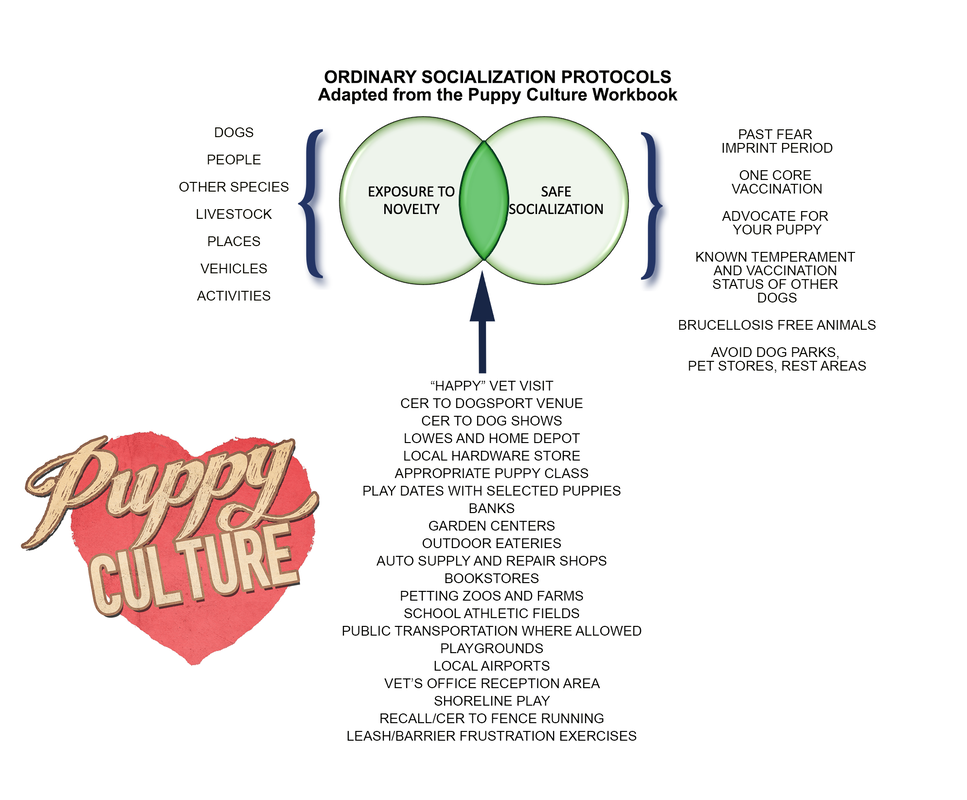
Back in the day, (like, last week) socialization was a pretty straightforward weighing of risk benefit based solely on risk to the puppy- bottom line, wait until an appropriate age and vaccination status, stay away from high risk areas for canine infectious diseases and advocate for your puppy so that every encounter is a positive one:
Picture
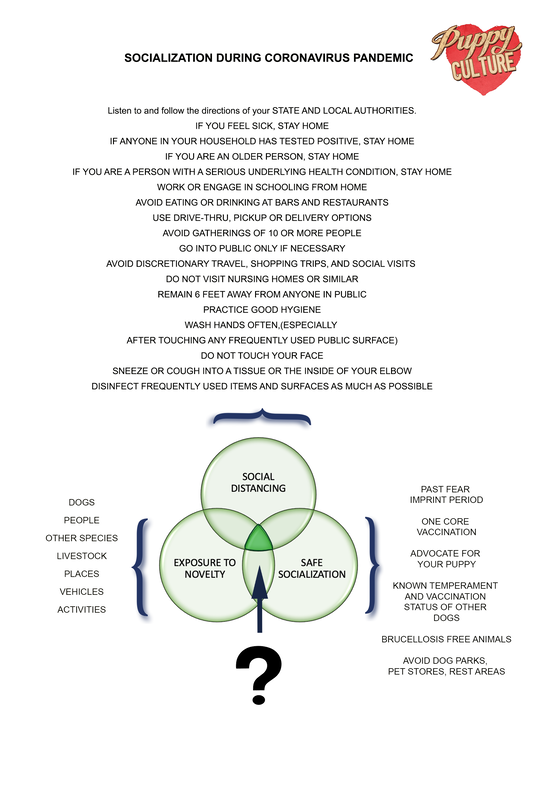
But in the space of a week, coronavirus has changed everything and now governments in virtually every country are asking us to practice "social distancing" which is, on its face, contrary to socializing puppies.  So now the puppy socialization diagram looks like this:
Picture
With that big, fat question mark on the bottom.  The good news is that, although the safe space for socializing puppies has just gotten a lot smaller, it's still there.  So let's look at what we CAN do and what we SHOULD do.
Two points to consider regarding our normal assumptions about socialization of puppies:
  • In their seminal work on socialization, Scott and Fuller accidentally discovered that puppies just seeing a person standing passively from the shoulders up behind a fence did in fact become at least partially socialized to humans.  So actual contact with novel humans and things may be optimal, but a lot of benefit can still be had from a puppy just observing stuff.
  • Dogs relate to their world much more through their sense of smell than any other sense.  As primates, we are focused on touching, holding and caressing, particularly front to front contact.  Dogs naturally prefer to pick up information via scent, and that sense of smell is astounding - from Nova's article, "Dog's Dazzling Sense of Smell": 
    • "Dogs' sense of smell overpowers our own by orders of magnitude—it's 10,000 to 100,000 times as acute, scientists say. "Let's suppose they're just 10,000 times better," says James Walker, former director of the Sensory Research Institute at Florida State University, who, with several colleagues, came up with that jaw-dropping estimate during a rigorously designed, oft-cited study. "If you make the analogy to vision, what you and I can see at a third of a mile, a dog could see more than 3,000 miles away and still see as well.'"
These two points add up to meaning that your puppy can still get lots of beneficial socialization by seeing things and smelling them while you maintain a safe social distance.   With that amazing sense of smell,  you can stay quite far away from other people and your dog can "see" them with his nose very clearly.

What is social distancing, anyway?  Good question.  The answer is something of a moving target but in sum it's minimizing non-essential contact with other humans to slow the spread of the coronavirus.  For healthy adults with no risk factors either for having been exposed or being at risk because of a health condition, the President has issued the following directives:

  • ​Work or engage in school at home
  • Avoid eating or drinking at bars or restaurants (use drive through, pick up or delivery)
  • Avoid gatherings of 10 or more people
  • Avoid discretionary travel
  • Avoid discretionary shopping trips
  • Avoid discretionary social trips
  • Do not visit nursing homes or similar
  • Go into public only if necessary
  • Remain 6 feet away from anyone in public (which, by the way, only reduces, not eliminates, your chances of spreading the disease)
 
  • Social distancing is not something you can ethically choose to ignore. The US government and governments around the world have called upon us directly to slow the spread of the virus. "Flatten the curve" means that, while we can't completely stop the spread of the virus, we can keep the serious case numbers low enough so that our hospitals have enough ventilators and staff to care for the critically ill.  So that hospitals don't have more people needing ventilators than are available.  So that medical staff does not have to make decisions about who gets to live and who gets to die. Like in Italy, this week.
  • ​Currently, the US government is asking us for serious social distancing for 15 days.  There's more than enough you can safely do to keep you and your puppy busy and moving forward during that time, after which any puppy should still have at least a flexible period for more "hands on" socialization. That period may or may not be enough to adequately slow the spread, but let's take it one step at a time and do the right thing now. Update Friday, March 20, 2020:  The governors of California and New York State have ordered 100% of non-essential workers to stay home.  Notwithstanding anything in this article, please comply with all federal, state and local laws.

Based on all of these considerations, I've come up with three rough categories for socialization protocols:
  • Green light, meaning go right ahead
  • Yellow light, meaning OK under the right circumstances
  • And red light, meaning not advisable
 First, the green light activities:
  • Drive to new places and allow your puppy to watch the outside world from within the car with the windows rolled up.  Have your puppy ride safely in his crate to each location and then take him out of his crate but stay inside the car when you arrive.  Be ready to give your puppy treats when people approach the car to wave though the glass.  This may also present an opportunity for you to counter condition any budding barrier frustration or car guarding your puppy might have. 
  • Work on recalls and creating good conditioned emotional responses (CERs) to barrier frustration, fence running and moving objects on your own property
    • ​Human household members walking on the other side of the fence
    • Household dogs walking on the other side of the fence
    • Motorized equipment and vehicles
  • Work on leash frustration by parallel walking on your own property with another household dog handled by a household member
  • Power up generalized positive responses to "weird sounds" using Susanne Shelton's protocol here is a link to a previous live event where she explains everything, it's pretty amazing!
  • Attention is the Mother exercises at home using various distractions:
    • ​Household members approaching
    • Other dogs handled by household members approaching
    • Household members touching - foundations for stand for exam
    • Sound distractions
  • Sound socialization recordings
    • ​Passive habituation to sounds
    • Active training and performing learned behaviors for reward with sound in the background
  • Free shaping interaction with novel surfaces and unstable surfaces - something as simple as a large diameter magic marker taped to the bottom of a piece of plywood.  Half a tennis ball glued to the bottom of a yoga block, a snow saucer - this does not have to be expensive or fancy equipment!
  • Free shaping multiple behaviors, both indoors and outdoors on your own property and in as many different rooms as possible.
  • Dress up in various outfits including hats, glasses, wigs, different shoes, etc.
  • Have other dogs in the household wear head cones and bandages
  • Play with other dogs and people in your own household

Whew!  If you're lucky enough to have at least one other household member and one other good dog, you can keep extremely busy with this for the next two weeks and, who knows, all this emphasis on ignoring and emotional regulation just might be as good or better than if your puppy actually interacted with other people and dogs in an unregulated fashion during this time.  At the very least, you'll be removing the possibility of having a negative experience with another dog or person which is a very good thing.

Next, we'll talk about "red light" activities that are no longer advisable: 
  • Non-essential vet visits
  • Dog shows and dog sport venues (which are all cancelled, anyway)
  • Group Puppy Class
  • Public Transportation - even if you HAVE to take public transportation for some reason, you don't want a puppy magnet with you, inviting people to violate your safe distance
  • Non-essential shopping trips
  • Socialization visits to other people's houses
  • Play groups - even if you think you can keep your distance it will be remarkably difficult to wrangle puppies and do the safe and productive thing for them and keep your distance from the other pet parents.  There will be times when you all have to go in and get your puppies and be super close to one and other.
  • Any other activity that puts you in a position where you might have to come in contact with other people - contact being defined as closer than 6'. 

Finally, let's talk about the "yellow light" areas I can't make a decision for you about these items, but I can give you thoughts about making your own decisions.  
  • Your puppy's age and previous socialization experience will come into play, here.  What is discretionary for one puppy may be essential for another.  For instance, I would not bother with most of these activities because my 12 week old puppy has already had a lot of contact with the outside world and she rocked it out with no hesitation. It's just not worth the trouble for me to take the necessary precautions to do most of these activities.
  • But if I had a younger puppy, or a puppy that had more difficulty with her previous socialization, I might avail myself of more of these "yellow light" activities.

So, here are some ideas which I present to you, but I advise a great deal of caution with them:

  • If you have to make an essential trip to a dog friendly venue, you might bring your puppy. But keep in mind that your puppy will attract people to you.  Are you able and prepared to tell people to keep away?  Do you really think you can maintain that safe 6' social distance with an adorable puppy in your arms?  How crowded do you expect the place to be?  If it's a sole proprietorship you might be able to call ahead and explain the situation.  If it's a big box store you're unlikely to be successful in keeping people away.
  • Neighborhood walks if safe from off leash dogs and you will not encounter any pedestrians that you cannot avoid.  See above regarding the difficulties of fending off "puppy fans."  Furthermore, I generally don't love taking my puppy anywhere with any chance of an off leash or "invisible fence" encounter.  Even in regular times, I feel the risk is too great of emotional damage from walks in the neighborhood to justify this activity with a puppy in suburban areas, and you will have difficulty avoiding people in more urban areas where the risk of off leash dogs is less.  For me, this is a no-go but you can make your own decisions based on your particular circumstances. 
  • Visit farm/livestock in rural areas - same considerations as above - can you guarantee there will be no loose dogs or "puppy fans" that you can't fend off?  A nice compromise might be to do a safari where you park, stay in the car, hold the puppy on your lap and roll the window down so he can hear, see, and smell everything
  • Nature Sniff N Strolls - You could take your puppy on a sniff-n-stroll in a natural area where there are steep slopes that keep the "sunday driver" pet owners away and very few people care to go.  But that is really above the paygrade of most puppies (see our Puppy Exercise Article) so it's logistically difficult.
  • Drive to a venue, park your car, keep your puppy in  his crate and open the hatch or door so he can see, hear, and smell everything going on.  Post office, store parking lot, bank parking lot.  Same issues with keeping people away as above, but this is the one I would be most tempted by and probably worth the effort to keep your distance.  You might even set up an exercise pen around the open portion of your vehicle to keep people at a distance, if feasible.
  • Using visitors and visiting dogs on other side of your fence at least 6' away
    • Practice recall and CER to leash and barrier frustration
    • Use as distractions for Attention is the Mother protocols
  • Rent a training building - virtually all group classes have been cancelled so you should not have a problem getting a rental.   But keep in mind that this is still a public place so use appropriate biosafety precautions - don't touch your face, wash your hands, wipe down anything before you touch it.  And I'm assuming you are not in the epicenter of an outbreak...the actual risk will depend on your local outlook
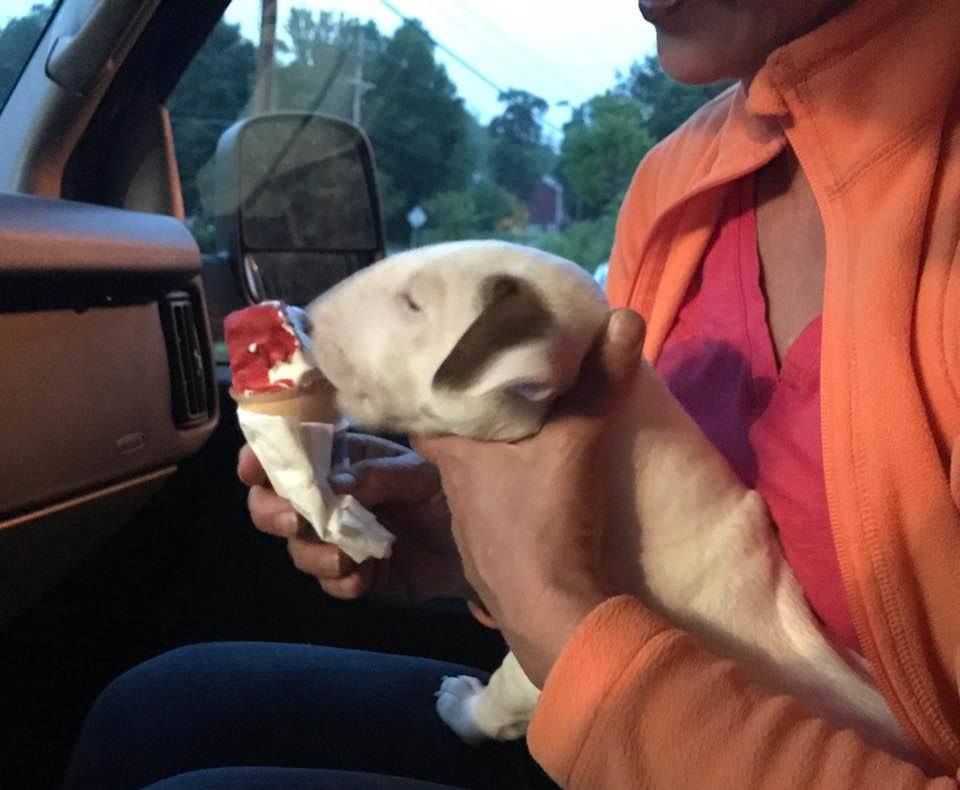
  • Go to the drive through and buy your puppy a cone - I would feel comfortable doing this as food in general is not a good vehicle for the virus, but use these precautions with your take out food. I would bring my own napkins and remove any paper from around the cone. 
  • Private lessons maintaining a 6' distance, preferably outdoors on a warm, sunny day- Again, assuming there are no other risk factors, you should be able to take a private lesson if you and your puppy remain inside a closed ring and the instructor remains outside the ring and maintains the 6' distance no matter where you are.  Coronavirus will have a harder time living on the more porous surfaces outdoors that are exposed to sun and warm temperature.
  • ​Closed System Socialization - if you have a friend that you trust, and that friend has a dog or puppy that is suitable for socializing with your puppy, and both you and your friend have truly been in isolation for two weeks and plan on remaining that way, you might actually do a playdate.  I don't actually know anyone who fits this category, but I imagine there might be some out there.
  • Curbside drop off - Some dog schools and daycares are offering curbside drop off - the puppy gets socialized by the instructors and the owners do not attend class.  Similarly, some puppy owners are doing puppy swaps with curbside drop off, again, so that the humans never need to come into contact with each other.  I'm really not sure about this as a coronavirus hazard - my yellow light with this is more that I would find it very hard to entrust my puppy to another person this way. We can't lose sight of the fact that it's better to do nothing at all than to have something bad happen to your puppy.  I could definitely warm more easily to doing a curbside drop off to or from a trusted friend or trusted trainer who was going to be working with my puppy one on one with dogs that I also know and trust. 
Picture
Getting a cone at the drive through has always been a rite of passage for our puppies, and it's still safe to do.

So, what am I doing with my 12 week old puppy? Well, as luck would have it, I just got back from Australia on Tuesday so unfortunately I don't have a lot of options.  Australia is generally much safer than almost anywhere else in the world, but I had to pass through three airports to get home.  I'm feeling great but I'll be staying put in my house for two weeks from the time I travelled, just to be sure.

Fortunately for us, Alana really did so well with her first off premises socialization that we're not in a rush to push things for the next two weeks. We have a house full of dogs, up until this week we had a house full of people each day, and I did do a lot with her early on.  I will probably do some "closed car" things, but, other than that, I don't see the need to go off premises right now and will concentrate on my "green light" list. 

Once I've been back in the country for two weeks, I'm going to set up some private agility lessons, preferably at my outdoor facility but even indoors I feel we can conduct the lessons safely.  I feel that getting Alana out to understand that novel places mean we train and work together is very important, so that will be a priority for me. I may also be renting a building for training. I have no current plans for socialization with outside dogs or people, but it so happens that because Alana was a singleton I've done a lot of that work with her already - much earlier than I would ever do with a litter, so she has that in her favor.

I think you see how personal these decisions become, based on your unique situation and your puppy's unique set of circumstances. The takeaway from this article is that, 
at the end of the day, any socialization where you can ensure social distancing, yet still control and curate your puppy's experience, is fine. That can look very different, depending on the circumstances, and I don't pretend to have every possible scenario covered here, but I think now you have some good guidelines for making decisions.

All that having been said, as I mentioned at the beginning, it's important to remain fluid and responsive to risks in real time and comply with all federal, state and local laws.  I will be updating this article as necessary but in the meantime, be safe, be careful with your puppies, and be kind to the community!

Wednesday, March 18, 2020

Play Biting is NORMAL

PLAY BITING

Puppy teeth – yes indeed they do hurt! Puppy biting is a perfectly natural behavior. Puppies use their mouths to explore their surroundings; nothing is sacred from puppy teeth. They also use their teeth when playing. Fortunately this is something they usually grow out of when they lose their puppy teeth at around sixteen weeks. Puppies themselves learn that their teeth are sharp when they are still with their mother and littermates. They begin to hurt their mother’s teat when feeding and she will get up and walk away. The pup learns there is a consequence to using teeth. They also learn the consequences of using their teeth too hard when playing with their littermates. If they use their teeth too enthusiastically the game will end one way or another. Either their littermate will yell in pain and stop playing or they may end up fighting.

Remember that dogs only have one defense if they are in pain, frightened or cornered and that is to use teeth. This does not make a bad dog it is simply dog behavior!

Your job is to teach the dog that teeth on human skin are not allowed! You also need to teach him to have a soft mouth. To help him learn to inhibit his bite you need to act like a playmate. Never use your hands or body as a toy when playing with your puppy. Instead use a suitable toy.

If your puppy catches your skin or clothes when you are playing yell ‘ouch’ – a good high pitched yell is needed as though he really hurt you. Get up, move away from your puppy and stop playing. Redirect his teeth onto something more acceptable, a stuffed Kong, the cardboard innards of toilet roll or kitchen roll, a toy or a nylabone or chew. (Don’t give your puppy cheap plastic toys to chew, as they can be dangerous if swallowed.)

Many puppies under 14 weeks will back off when you yell then come back and lick you. Praise and redirect the play onto something appropriate. Some puppies will see the yell as a cue to lunge at you even harder. These puppies are usually over stimulated, over tired or perhaps Terriers! Do not shout, do not use a water pistol, do not scruff or shake, simply remain calm, get up and walk away. Ensure your puppy is getting enough rest during the day – especially if you have children.  Place your puppy on a good diet as some diets have been implicated in effecting behavior. Make sure that everyone in the household treats your puppy the same way. Children should always be supervised when they interact with your puppy, as young children tend to flap their arms around squealing, which only excites the puppy.

Stopping a puppy play biting takes time and consistency. Puppies will latch onto to anything that moves – your trouser leg, the bottom of your dressing gown and your toes! Why, because it gets a reaction from the owner. If this happens, stop walking. Do not get into a game of tug with your trouser leg or dressing gown. Try and redirect your puppy onto something more acceptable.

Being proactive instead of reactive will safely teach your puppy where and when he can use his teeth.

www.apdt.co.uk

Tuesday, March 17, 2020

Puppy Socialization in the Age of Coronavirus


Puppy Socialization in the Age of Coronavirus

by Gayle Watkins | Mar 17, 2020


Holy cow! What do we do now? For decades, we’ve been told that to raise stable puppies we need to socialize them with many people of different genders, sizes, ages, races, etc. And, we were told that socialization had to be done before 16 weeks of age. That’s the only way to ensure pups would be friendly and confident as adults. 

But the world has changed due to the coronavirus and with it our rules for engaging with other people. Although dogs don’t get ill from this version of the virus, there is concern that they can carry it on their coats, thus transferring it between people. Many puppy kindergarten classes are canceled and dog-training facilities are closed. If we meet people in our neighborhood or on the street, we are supposed to stay at least six feet away from them and not let our puppy interact with them. What is a puppy breeder and owner to do?

Socialization and Development is Still Essential.

Meeting and interacting with an array of people is important to the social development of young puppies. From ages 3 weeks up to 16 weeks, pups are particularly sensitive to social engagement with other dogs, people, even other pets and livestock. In ideal circumstances, we would ensure they met 50 or even 100 people during these early months. However, these aren’t ideal times for anyone. 

Eight Tips for Continuing to Socialize Your Puppy.

So, let’s talk about eight things we can do to raise stable, friendly pups during the Age of Coronavirus.

1) Focus on building your pup’s trust in you and your family. The most important lesson for pups to learn in these early months is to trust people, especially their people. During this time, focus on building that trust through teaching communication, cues, house manners, tricks, and fitness exercises. Practice these things in each room in your house and every part of your yard. Your pup’s trust in you, above all else, will enable you to pick up his socialization again once this is over.

2) Go all chameleon. If your pup can’t meet folks who look different, then change the way you look! Use masks, wigs, hats, umbrellas, cloaks, and more. Have your family play along! Pop up looking like Halloween throughout your house and property, not in a scary way but in a surprising way. Try manipulating your smell, too. You can’t actually change your odor, which is very important to dogs, but you can spritz yourself with some light scent to add to the way you smell.

3) Set up challenging, stimulating experiences at home. Puppy brains and bodies need to be challenged during these months, so think of ways to do this at home. Create obstacle courses in your house or yard. Play scent games, hiding treats for your pup to sniff out around the house and yard. (Just remember not to violate house rules during this game, so no treats on counters.) Let your pup solve all kinds of problems (e.g., how to find you in the house and to solve dog puzzles.)

4) Do Adventure Walks! We may not be able to gather in groups but we can head out into the great outdoors. Make an effort to get your pup to woods, meadows, fields, beaches, and even parks. Adventure Walks enable pups to learn responsibility and problem-solving as well as develop their brain-body connection. And best of all, Adventure Walks tire pups out! We are recording an Adventure Walk webinar this week, so we’ll send out a note when it’s done. Sign up for our mailing list to be informed!

5. Introduce your puppy to as many safe people as possible. Most likely there will still be some safe people in your life. They might be family members, neighbors, or tenants who are staying put at home. Let your pup interact with as many people as you safely can.

6. Let pups see people, places, and things! Even if you can’t introduce your pup directly to new people, your pup can still be introduced to the world. These indirect interactions, where pups see and hear but don’t touch are very important for teaching puppies proper manners. Think through what you want your pup to do when it can see another person or dog but can’t approach. Then teach that behavior to your puppy.Take short trips to let your pup see and hear whatever is happening. No doubt, life is going to be quieter for a while so this may take some effort. Look for garbage trucks, traffic, fire departments, and anything else noisy and hang out with your pup.

7. Get your pup off your property. Pups become location sensitive towards the end of this period, attaching them strongly to their homes and yards. Since we want our pups to be comfortable in many places, we need to get them away from the house. Drive your pup to different places in your area where people aren’t congregating. Playgrounds, parks, outdoor shopping malls, and store parking lots. Take your pup for a ride in a wiped-down shopping cart. Let her jump up on park benches. Invesitigate the playground equipment. Check out dog parkour may give you more ideas but be sure to keep all activities age appropriate so no jumping off of high places.

8. Emphasize handling, grooming, and examinations at home. Most likely your pup will be doing fewer visits to the vet and groomer during the pandemic, so you have to take responsibility for teaching your pup to tolerate handling, touching, and manipulation. We have a blog to help with this. Check it out here.

Get Going.

These are our suggestions for socializing pups during the Age of Coronavirus. They aren’t as ideal as doing traditional socialization but it’s the hand we have been dealt. Interacting with your puppy will also help you handle the stress of the current situation. 

So, develop a plan and get going with your pup. If you have other ideas for puppy owners, please drop us a note or post them in the comments to tell us about them. We’ll post them soon. And feel free to share this post with anyone you know raising a pup or puppies right now.

Monday, March 16, 2020

Field Trip and our first bird wing!

We're going on a field trip? What's that?

Oh yes! Baker on the move!

Bowen sampling some yummy grass!

The chase is ON!

Oh YUM!


Gonna gotcha!

Poolside chillin!

Lapdogs in training . . .

The pups had a blast on their first field trip to San Clemente. A couple of them fell into the pool and/or koi pond and were quickly fished out and towel dried. None were the worse for wear. They also had an impromptu demo on "wing on a string" which gets them interested in bird scent and ignites their prey drive. More photos are in the Puppy Photo Album!

Thursday, March 12, 2020

Info on puppy pen setup for your new best friend

Puppy management is the best way to ensure success for your new puppy. This includes, gates/crates and setting up the puppy for success by providing a potty area or 24/7 "two eyes on the puppy" to take pup outside to potty. 

If you need to contain the pup while doing something else, below is an example of great setup. 

Future Owners: feel please ask me for clarification on how best to organize your puppy pen. Note - artificial grass is preferred. 


A lot goes in to bringing home a new puppy, including setting them (and you!) up for success as they learn what behaviors are ok when they live in a human house! 
One of those successful set-ups is a puppy playpen! This area will be a safe place for your puppy to spend time during the first few weeks after they arrive home.

A few things go into setting up a good puppy playpen, including where you position each station! Here is one idea for what this playpen might look like, although your individual house set-up should inform exactly how your pen is put together.
The bottom line is thinking about the behaviors you want your puppy to do (or not do), and setting up their environment to facilitate those good choices as much as possible!
Credit: https://www.facebook.com/summitdogtraining

Tuesday, March 10, 2020

Six Weeks Old!


The BB's are six weeks old! Time is flying by -- I keep saying that but it's true!

They are having a blast exploring their outdoor area and getting better (thankfully) at going potty on their indoor grass/potty box. 

The puppies have been introduced to the Clicker and are doing advanced Manding (see previous post on Puppy Culture). 

They are also sleeping through the night in a one big crate which I will swap for two as all eight pups are barely able to fit inside. 

They've had several visitors for socialization following strict hand washing and disinfecting protocols (better to be safe than sorry). 

Saturday, March 7, 2020

What is Puppy Culture "Manding"?

Reminders/info from Jane Messineo Lindquist from Puppy Culture

This is a global "Manding" post - we get more questions about manding than any other PC protocol, and it's also the most misunderstood protocol because it's so often confused with "sitting politely for petting" which is a completely different concept. So here are the links with all the information you need on manding:

http://bit.ly/IAABCMANDING - my article in the International Association of Animal Behavior Consultants on manding which describes the history of the concept, its basic application, and benefits.

http://bit.ly/MANDINGFAILURE - my article on what manding is and is not and why puppies who are taught to mand will (and should) still jump up on people sometimes

http://bit.ly/MANDINGDISCRIMSTIM - my article on how and when to honor the mand, and how and when to let the puppy know that his opportunity for petition is closed at this time ;).

Original post: https://bit.ly/2ZpNcWE

Monday, March 2, 2020

5️⃣ things for successful dog ownership . . .

Five things that we want pet owners to know about successful dog ownership: 
  • Crate train. Even if you leave your dog out when mature, crate train. Most issues with destruction, eating things dogs shouldn't, and many other issues are solved by crate training. And consider transporting your dog safely, stay overs at a boarding facility or the vet's, or needing to leave them in a room with a raw steak on the counter. Crates are the answer for that too!
  • Socialization isn't about meeting other dogs and people. Really. It isn't. It's about exposing your dog to the daily world and teaching them to focus on you. Would you believe me if I told you my dogs have never been to puppy play groups, they never ever say hi to other dogs on walks, and they certainly don't say hi to people either unless permission is asked and given? That's actually normal! Let your dog have one or two friends and that's seriously good enough.
  • Dog parks- we don't use them, but if you must, use extreme caution. Seriously. Go ask a long time breeder, sport handler, or working handler what they think of dog parks. If you absolutely can't imagine life without them, take precautions!
  • Keep your dogs away from other dogs out and about. We don't care if they are friendly, and we don't care if they won't hurt anything. You and your dog don't have the right to interact with others, and you never know when a dog is sick, injured, training, working, or reactive. Use the leash, and don't come within 30 feet without asking first.
  • All dog owners should learn the basics of body language. In my opinion, this is far more important than teaching a dog to sit. You need to know how your dog feels about things and you need to be able to read a situation.
  • Bonus: Don't let your dog stare at other dogs. Bad plan. Even with the little ones. People always wonder why my dogs hackle at the little ones yapping and pulling at the end of the leash- those little ones are being confrontational. Help other dog owners by making sure your own dog is acting appropriately and focused on YOU.

Source: Manitoba Dog Training and Ethical Breeding Education

PRIMARY SOCIALIZATION: DAY 20-WEEK 6


The BB's are going to be 5 weeks old tomorrow (March 2nd).

They have moved from the whelping box to their Puppy Party Palace (they actually have two) which is a linoleum lined gated area with potty, bed and play areas. They are learning to use the potty box area but with eight there are bound to be mistakes. Most of my free time is being spent as the sanitation worker trying to keep the area as clean as possible in the hopes they will eventually potty in a designated area (cross your fingers for me!). 

They are sleeping on a Kuranda raised bed covered in blankets and there are soft blankets on the floor (and pee pads) for traction and wetness control (urine). They also have a hard plastic crate to nap in if they choose (eventually there will be eight crates). 

They love the Puppy Toy Mobile (with hanging objects) and are having fun with each new toy/experience per day. 

For those familiar with Puppy Culture the puppies have done the "barrier challenge" to learn to problem solve for themselves which reduces frustration in adult dogs. Future puppy owners -- please be sure yo are watching the Puppy Culture DVDs (thanks!). 


PRIMARY SOCIALIZATION PERIOD: DAY 20-WEEK 6

The first socialization period begins at two-and-a-half weeks of age and lasts until six weeks of age. This is when the puppies learn how to be dogs, so to speak. They become familiar with all the species-specific behaviors that allows them to live and communicate with other dogs, such as different body postures and vocalizations. They also learn how to bite and what it feels like to be bitten. This is an important lesson for puppies to learn when they are young, so they do not hurt other dogs and people as adults. The mother also teaches the pups very important lessons on discipline and dog-manners. Puppies will also begin to move to specific locations to potty, preferring not to mess up the den or whelping area.

Wednesday, February 26, 2020

Preparing for Puppy!

I am super excited about the awesome families selected for the BB's and we have been discussing preparations for when the pup comes home.

This link was shared in the Puppy Culture Facebook group and it is an excellent setup for a new puppy if you need to leave them unattended for any length of time. Please go the entire link for details:
https://www.facebook.com/permalink.php?story_fbid=766465327095211&id=595861667488912

Below is a snippet - credit to Pawsitive Obsession

"Litter box is stationed in the back corner so that it is away from resting area and not in a place puppy will be walking to try and access us.
The ex pen and litterbox are for times that there isn't anybody available to supervise the puppy so she doesn't practice having accidents in the house but also isn't confined to a crate and forced to hold it or go to the bathroom and lay in it. My new puppy and I are very fortunate to have a breeder who works so hard to help her puppies learn to be clean and know how to use a litterbox from a very young age!!
I will need to get another water bowl because this one will tip over easily, so for now I have it placed as much out of the way as I can and a washable puppy pad under it to soak up any spills."  NOTE: The BB's are being litter box trained on fake grass. 
"The red sheet is hung up in the corner that has the litterbox, this sheet will stay up as long as the litterbox remains in the ex pen. This sheet will help to guide the puppy to another part of the ex pen to watch activities going on in the living room so she's not walking through the litterbox.
The brown sheet will only go up if what is going on in the living room is too much for her, or it is time for her to nap. "

Monday, February 24, 2020

Puppy Culture - Enrichment & Socialization "Something New Every Day"

The puppies will continually exposed "Something New Every Day". Some great ideas below, let me know if you think of anything else!

Our 2013 Litter drinking from a hose

- Music Mat
- Sit N Spin
- Baby slide
- Crackle toys
- Squeaky toys
- Plush toys
- Walk on grass
- Walk on tin foil
- Play in kiddie pool
- Bubbles
- Cold toys (teething)
- Paper towel rolls
- Empty box
- Mirror
- Yoga block
- Walk on gravel
- Introduce bumper bed mat
- Grooming tools in box
- Stand on grooming table and eat treats
- Be brushed with pupy brush
- Show stack and eat baby food / yogurt to hold still
- Walk on carpet
- Walk on tile
- Introduce puppy mush
- Have friends come to visit
- Have trusted adult dog of friends visit
- Meet cat (if applicable. I have one.)
- Listen to classical music
- Listen to Puppy sounds CD
- Introduce small tunnel
- Puppy playmat with dangling toys
- Play with a ball that rolls (beach ball or something light)
- Introduce dremel (just hearing seeing, touching toes with dremel off)
- Introduce actually dremeling toenails (8 weeks)
- Clip nails
- Ball pit
- Car rides
- Walk up and down steps
- Loud noise - i.e. lawn mower
- Moving objects - car, bicycle
- Meet other animals (goats, rats, horses, etc.)
- Watch kids jump on a trampoline
- Play in a dry bathtub
- See or go in a Tent
- Plastic milk bottles
- Large bubble wrap (before they are big enough to eat it)
- Change of environment - move to new pen or visit new areas of the house
- Vaccum cleaner
- Lawn mower
- Broom
- Washing machine
- Various food puzzle toys
- Empty plastic bottles and cans in a ball pit
- Skateboard or toy that moves if they get on it
- Wobble disc
- Sound toys
- Electric toothbrush to simulate being clippered/groomed
- Banging pots/pans
- TV on various channels
- Different kinds of music
- Turning on ceiling fan/window fan
- Plastic bags, the kind that blow in the wind
- Children of all ages
- A fan on the floor outside of the pen blowing in

Currently, eating . . .


The puppies are hungry! They've started on goats milk and Honest Kitchen Grain Free (Chicken or Fish) as well as some of my recommended probiotic supplements. They also had a taste of minced raw chicken and will be weaned onto premade raw as well as oatmeal and their current diet. So far they are LOVING IT!

Emery is a fastidious mother and still wants to feed them but she is having a hard time making enough milk for the eight babies. She is currently eating around 5 lbs. of food which includes raw, cottage cheese, Honest Kitchen, cooked lean meats, veggies and whatever else she can get her teeth on!

Example: She pulled a cooked spaghetti squash off the counter which was intended for human consumption. There is no way I can be mad at her!!! 😘

Wednesday, February 19, 2020

The 10 Most Important Things to Teach A Puppy


WDJ is an excellent resource for all things dog! Another great article below... (see link):
It shouldn’t surprise me but it does, still, that there are far too many people out there who don’t seem to have a clue about how to properly raise a puppy. Whole Dog Journal readers are not likely to fall into the “completely clueless” category, but in case you haven’t had a puppy for a while – or ever – and recently adopted or are thinking of adopting, here’s a refresher course for you on the topic of the 10 most important things you should teach your puppy.

Tuesday, February 18, 2020

Calmness is a learned behavior 😇


This video is a tutorial on how to teach your puppy or dog to be calm.


Some dogs need help to learn how to relax. Calmness does not come naturally to some breeds .By reinforcing your dog for being calm, your dog will start to choose calmer behaviors in the future and actually enjoy being calm.

Tips for teaching a Default Settle:


  • Don't drop treats if the dog looks up at your hand as you move to give the dog the treat, instead try again later.
  • Don't cue the dog "down". It works better if the dog figures it out on his own and CHOOSES to lay down.
  • Use high value treats like real meat or cheese for such a wonderful behavior.
---

A wonderful friend and fellow Vizsla Breeder, Janet Galante, owner of Sit! Stay! Play! in Tucson, AZ posted this lovely photo and comments.

"People often ask me "how do you do that" when they see dogs happily in free play without barking or resting quietly without restraint at Sit! Stay! Play!. There are lots of reasons including the creation of a low stress "culture", but the main reason is having dedicated, intelligent, caring, and well trained employees like Tracie Brennan. We have been moving our nap periods to the play floors and teaching the dogs it is time to take a break has been a process. I am so proud to have so many talented people working with me."