Showing posts with label Basic Training. Show all posts

Saturday, April 18, 2020

Puppies Won’t Wait - Socialization during the COVID19 pandemic by the Ultimate Puppy

Puppies Won’t Wait

This pandemic has changed a lot of things, including how we approach our Socialization Strategy with young pups. But it hasn’t changed the fact that this stage of development ends early. The goal to introduce your puppy to a variety of people, places, surfaces and sounds before they are 16 weeks remains the same. We must do this as responsible citizens and responsible puppy people. Ultimate Puppy is here to help.

Friday, March 20, 2020

Socializing Puppies During The Coronavirus Pandemic


Let's talk about the question that has to be foremost in any breeder's mind right now...socialization during the coronavirus pandemic. I'm in this situation myself with a 12 week old puppy in my house that normally would be in the midst of daily exposures to important things. I've taken a hard look at my past research on socialization and viewed that in light of the US government's call for measures to stop the spread of the virus, and I have, if not a plan, at least a distilled version of the considerations, with some definite "dos," some definite "don'ts" and some definite "it depends." But I will say at the outset this is all very fluid so, in the end, you have to be alert to changing facts and use your own judgement.
Update Friday, March 20, 2020:  The governors of California and New York State have ordered 100% of non-essential workers to stay home.  Notwithstanding anything in this article, please comply with all federal, state and local laws.
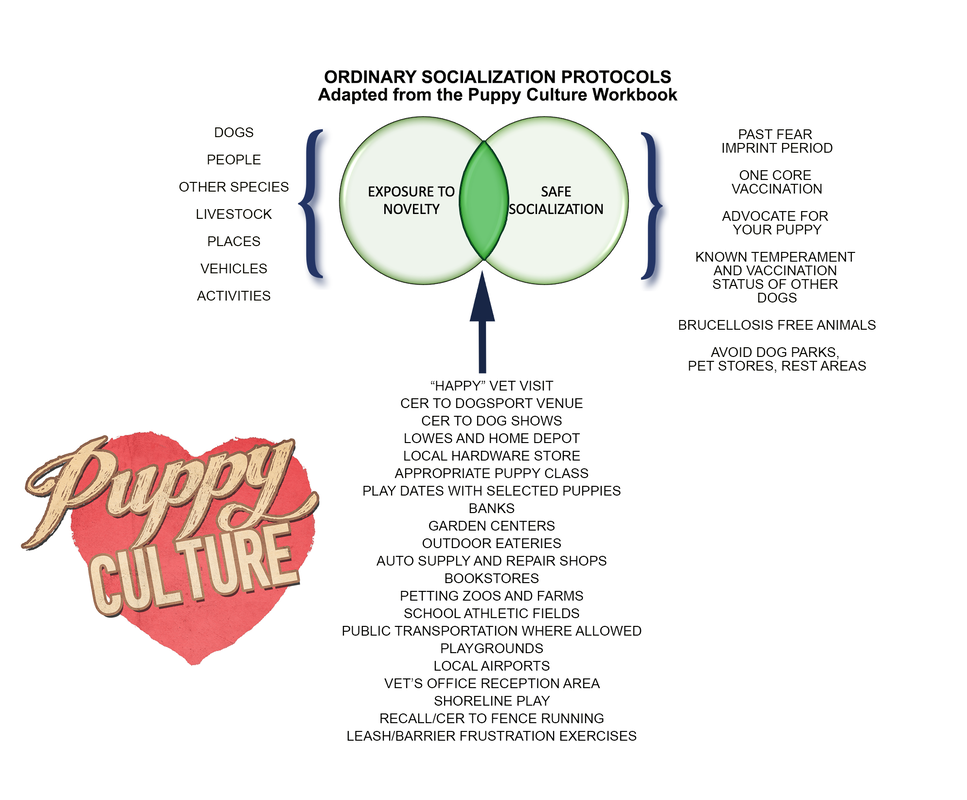
Back in the day, (like, last week) socialization was a pretty straightforward weighing of risk benefit based solely on risk to the puppy- bottom line, wait until an appropriate age and vaccination status, stay away from high risk areas for canine infectious diseases and advocate for your puppy so that every encounter is a positive one:
Picture
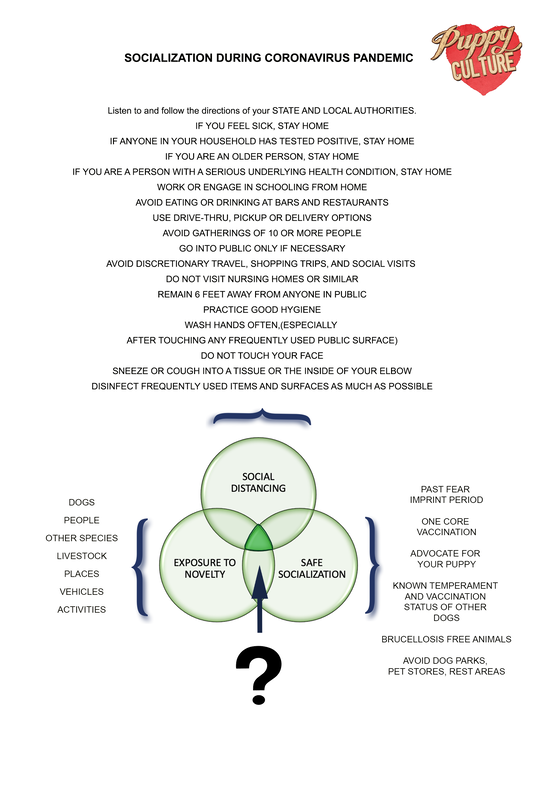
But in the space of a week, coronavirus has changed everything and now governments in virtually every country are asking us to practice "social distancing" which is, on its face, contrary to socializing puppies.  So now the puppy socialization diagram looks like this:
Picture
With that big, fat question mark on the bottom.  The good news is that, although the safe space for socializing puppies has just gotten a lot smaller, it's still there.  So let's look at what we CAN do and what we SHOULD do.
Two points to consider regarding our normal assumptions about socialization of puppies:
  • In their seminal work on socialization, Scott and Fuller accidentally discovered that puppies just seeing a person standing passively from the shoulders up behind a fence did in fact become at least partially socialized to humans.  So actual contact with novel humans and things may be optimal, but a lot of benefit can still be had from a puppy just observing stuff.
  • Dogs relate to their world much more through their sense of smell than any other sense.  As primates, we are focused on touching, holding and caressing, particularly front to front contact.  Dogs naturally prefer to pick up information via scent, and that sense of smell is astounding - from Nova's article, "Dog's Dazzling Sense of Smell": 
    • "Dogs' sense of smell overpowers our own by orders of magnitude—it's 10,000 to 100,000 times as acute, scientists say. "Let's suppose they're just 10,000 times better," says James Walker, former director of the Sensory Research Institute at Florida State University, who, with several colleagues, came up with that jaw-dropping estimate during a rigorously designed, oft-cited study. "If you make the analogy to vision, what you and I can see at a third of a mile, a dog could see more than 3,000 miles away and still see as well.'"
These two points add up to meaning that your puppy can still get lots of beneficial socialization by seeing things and smelling them while you maintain a safe social distance.   With that amazing sense of smell,  you can stay quite far away from other people and your dog can "see" them with his nose very clearly.

What is social distancing, anyway?  Good question.  The answer is something of a moving target but in sum it's minimizing non-essential contact with other humans to slow the spread of the coronavirus.  For healthy adults with no risk factors either for having been exposed or being at risk because of a health condition, the President has issued the following directives:

  • ​Work or engage in school at home
  • Avoid eating or drinking at bars or restaurants (use drive through, pick up or delivery)
  • Avoid gatherings of 10 or more people
  • Avoid discretionary travel
  • Avoid discretionary shopping trips
  • Avoid discretionary social trips
  • Do not visit nursing homes or similar
  • Go into public only if necessary
  • Remain 6 feet away from anyone in public (which, by the way, only reduces, not eliminates, your chances of spreading the disease)
 
  • Social distancing is not something you can ethically choose to ignore. The US government and governments around the world have called upon us directly to slow the spread of the virus. "Flatten the curve" means that, while we can't completely stop the spread of the virus, we can keep the serious case numbers low enough so that our hospitals have enough ventilators and staff to care for the critically ill.  So that hospitals don't have more people needing ventilators than are available.  So that medical staff does not have to make decisions about who gets to live and who gets to die. Like in Italy, this week.
  • ​Currently, the US government is asking us for serious social distancing for 15 days.  There's more than enough you can safely do to keep you and your puppy busy and moving forward during that time, after which any puppy should still have at least a flexible period for more "hands on" socialization. That period may or may not be enough to adequately slow the spread, but let's take it one step at a time and do the right thing now. Update Friday, March 20, 2020:  The governors of California and New York State have ordered 100% of non-essential workers to stay home.  Notwithstanding anything in this article, please comply with all federal, state and local laws.

Based on all of these considerations, I've come up with three rough categories for socialization protocols:
  • Green light, meaning go right ahead
  • Yellow light, meaning OK under the right circumstances
  • And red light, meaning not advisable
 First, the green light activities:
  • Drive to new places and allow your puppy to watch the outside world from within the car with the windows rolled up.  Have your puppy ride safely in his crate to each location and then take him out of his crate but stay inside the car when you arrive.  Be ready to give your puppy treats when people approach the car to wave though the glass.  This may also present an opportunity for you to counter condition any budding barrier frustration or car guarding your puppy might have. 
  • Work on recalls and creating good conditioned emotional responses (CERs) to barrier frustration, fence running and moving objects on your own property
    • ​Human household members walking on the other side of the fence
    • Household dogs walking on the other side of the fence
    • Motorized equipment and vehicles
  • Work on leash frustration by parallel walking on your own property with another household dog handled by a household member
  • Power up generalized positive responses to "weird sounds" using Susanne Shelton's protocol here is a link to a previous live event where she explains everything, it's pretty amazing!
  • Attention is the Mother exercises at home using various distractions:
    • ​Household members approaching
    • Other dogs handled by household members approaching
    • Household members touching - foundations for stand for exam
    • Sound distractions
  • Sound socialization recordings
    • ​Passive habituation to sounds
    • Active training and performing learned behaviors for reward with sound in the background
  • Free shaping interaction with novel surfaces and unstable surfaces - something as simple as a large diameter magic marker taped to the bottom of a piece of plywood.  Half a tennis ball glued to the bottom of a yoga block, a snow saucer - this does not have to be expensive or fancy equipment!
  • Free shaping multiple behaviors, both indoors and outdoors on your own property and in as many different rooms as possible.
  • Dress up in various outfits including hats, glasses, wigs, different shoes, etc.
  • Have other dogs in the household wear head cones and bandages
  • Play with other dogs and people in your own household

Whew!  If you're lucky enough to have at least one other household member and one other good dog, you can keep extremely busy with this for the next two weeks and, who knows, all this emphasis on ignoring and emotional regulation just might be as good or better than if your puppy actually interacted with other people and dogs in an unregulated fashion during this time.  At the very least, you'll be removing the possibility of having a negative experience with another dog or person which is a very good thing.

Next, we'll talk about "red light" activities that are no longer advisable: 
  • Non-essential vet visits
  • Dog shows and dog sport venues (which are all cancelled, anyway)
  • Group Puppy Class
  • Public Transportation - even if you HAVE to take public transportation for some reason, you don't want a puppy magnet with you, inviting people to violate your safe distance
  • Non-essential shopping trips
  • Socialization visits to other people's houses
  • Play groups - even if you think you can keep your distance it will be remarkably difficult to wrangle puppies and do the safe and productive thing for them and keep your distance from the other pet parents.  There will be times when you all have to go in and get your puppies and be super close to one and other.
  • Any other activity that puts you in a position where you might have to come in contact with other people - contact being defined as closer than 6'. 

Finally, let's talk about the "yellow light" areas I can't make a decision for you about these items, but I can give you thoughts about making your own decisions.  
  • Your puppy's age and previous socialization experience will come into play, here.  What is discretionary for one puppy may be essential for another.  For instance, I would not bother with most of these activities because my 12 week old puppy has already had a lot of contact with the outside world and she rocked it out with no hesitation. It's just not worth the trouble for me to take the necessary precautions to do most of these activities.
  • But if I had a younger puppy, or a puppy that had more difficulty with her previous socialization, I might avail myself of more of these "yellow light" activities.

So, here are some ideas which I present to you, but I advise a great deal of caution with them:

  • If you have to make an essential trip to a dog friendly venue, you might bring your puppy. But keep in mind that your puppy will attract people to you.  Are you able and prepared to tell people to keep away?  Do you really think you can maintain that safe 6' social distance with an adorable puppy in your arms?  How crowded do you expect the place to be?  If it's a sole proprietorship you might be able to call ahead and explain the situation.  If it's a big box store you're unlikely to be successful in keeping people away.
  • Neighborhood walks if safe from off leash dogs and you will not encounter any pedestrians that you cannot avoid.  See above regarding the difficulties of fending off "puppy fans."  Furthermore, I generally don't love taking my puppy anywhere with any chance of an off leash or "invisible fence" encounter.  Even in regular times, I feel the risk is too great of emotional damage from walks in the neighborhood to justify this activity with a puppy in suburban areas, and you will have difficulty avoiding people in more urban areas where the risk of off leash dogs is less.  For me, this is a no-go but you can make your own decisions based on your particular circumstances. 
  • Visit farm/livestock in rural areas - same considerations as above - can you guarantee there will be no loose dogs or "puppy fans" that you can't fend off?  A nice compromise might be to do a safari where you park, stay in the car, hold the puppy on your lap and roll the window down so he can hear, see, and smell everything
  • Nature Sniff N Strolls - You could take your puppy on a sniff-n-stroll in a natural area where there are steep slopes that keep the "sunday driver" pet owners away and very few people care to go.  But that is really above the paygrade of most puppies (see our Puppy Exercise Article) so it's logistically difficult.
  • Drive to a venue, park your car, keep your puppy in  his crate and open the hatch or door so he can see, hear, and smell everything going on.  Post office, store parking lot, bank parking lot.  Same issues with keeping people away as above, but this is the one I would be most tempted by and probably worth the effort to keep your distance.  You might even set up an exercise pen around the open portion of your vehicle to keep people at a distance, if feasible.
  • Using visitors and visiting dogs on other side of your fence at least 6' away
    • Practice recall and CER to leash and barrier frustration
    • Use as distractions for Attention is the Mother protocols
  • Rent a training building - virtually all group classes have been cancelled so you should not have a problem getting a rental.   But keep in mind that this is still a public place so use appropriate biosafety precautions - don't touch your face, wash your hands, wipe down anything before you touch it.  And I'm assuming you are not in the epicenter of an outbreak...the actual risk will depend on your local outlook
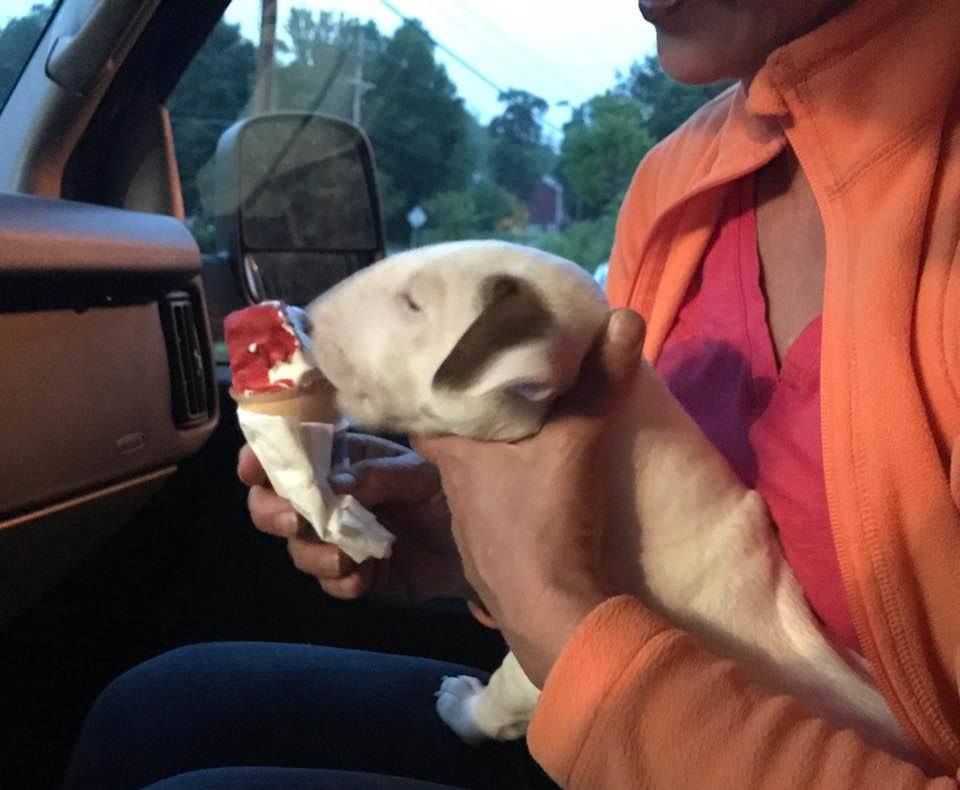
  • Go to the drive through and buy your puppy a cone - I would feel comfortable doing this as food in general is not a good vehicle for the virus, but use these precautions with your take out food. I would bring my own napkins and remove any paper from around the cone. 
  • Private lessons maintaining a 6' distance, preferably outdoors on a warm, sunny day- Again, assuming there are no other risk factors, you should be able to take a private lesson if you and your puppy remain inside a closed ring and the instructor remains outside the ring and maintains the 6' distance no matter where you are.  Coronavirus will have a harder time living on the more porous surfaces outdoors that are exposed to sun and warm temperature.
  • ​Closed System Socialization - if you have a friend that you trust, and that friend has a dog or puppy that is suitable for socializing with your puppy, and both you and your friend have truly been in isolation for two weeks and plan on remaining that way, you might actually do a playdate.  I don't actually know anyone who fits this category, but I imagine there might be some out there.
  • Curbside drop off - Some dog schools and daycares are offering curbside drop off - the puppy gets socialized by the instructors and the owners do not attend class.  Similarly, some puppy owners are doing puppy swaps with curbside drop off, again, so that the humans never need to come into contact with each other.  I'm really not sure about this as a coronavirus hazard - my yellow light with this is more that I would find it very hard to entrust my puppy to another person this way. We can't lose sight of the fact that it's better to do nothing at all than to have something bad happen to your puppy.  I could definitely warm more easily to doing a curbside drop off to or from a trusted friend or trusted trainer who was going to be working with my puppy one on one with dogs that I also know and trust. 
Picture
Getting a cone at the drive through has always been a rite of passage for our puppies, and it's still safe to do.

So, what am I doing with my 12 week old puppy? Well, as luck would have it, I just got back from Australia on Tuesday so unfortunately I don't have a lot of options.  Australia is generally much safer than almost anywhere else in the world, but I had to pass through three airports to get home.  I'm feeling great but I'll be staying put in my house for two weeks from the time I travelled, just to be sure.

Fortunately for us, Alana really did so well with her first off premises socialization that we're not in a rush to push things for the next two weeks. We have a house full of dogs, up until this week we had a house full of people each day, and I did do a lot with her early on.  I will probably do some "closed car" things, but, other than that, I don't see the need to go off premises right now and will concentrate on my "green light" list. 

Once I've been back in the country for two weeks, I'm going to set up some private agility lessons, preferably at my outdoor facility but even indoors I feel we can conduct the lessons safely.  I feel that getting Alana out to understand that novel places mean we train and work together is very important, so that will be a priority for me. I may also be renting a building for training. I have no current plans for socialization with outside dogs or people, but it so happens that because Alana was a singleton I've done a lot of that work with her already - much earlier than I would ever do with a litter, so she has that in her favor.

I think you see how personal these decisions become, based on your unique situation and your puppy's unique set of circumstances. The takeaway from this article is that, 
at the end of the day, any socialization where you can ensure social distancing, yet still control and curate your puppy's experience, is fine. That can look very different, depending on the circumstances, and I don't pretend to have every possible scenario covered here, but I think now you have some good guidelines for making decisions.

All that having been said, as I mentioned at the beginning, it's important to remain fluid and responsive to risks in real time and comply with all federal, state and local laws.  I will be updating this article as necessary but in the meantime, be safe, be careful with your puppies, and be kind to the community!
Wednesday, March 18, 2020

Play Biting is NORMAL

PLAY BITING

Puppy teeth – yes indeed they do hurt! Puppy biting is a perfectly natural behavior. Puppies use their mouths to explore their surroundings; nothing is sacred from puppy teeth. They also use their teeth when playing. Fortunately this is something they usually grow out of when they lose their puppy teeth at around sixteen weeks. Puppies themselves learn that their teeth are sharp when they are still with their mother and littermates. They begin to hurt their mother’s teat when feeding and she will get up and walk away. The pup learns there is a consequence to using teeth. They also learn the consequences of using their teeth too hard when playing with their littermates. If they use their teeth too enthusiastically the game will end one way or another. Either their littermate will yell in pain and stop playing or they may end up fighting.

Remember that dogs only have one defense if they are in pain, frightened or cornered and that is to use teeth. This does not make a bad dog it is simply dog behavior!

Your job is to teach the dog that teeth on human skin are not allowed! You also need to teach him to have a soft mouth. To help him learn to inhibit his bite you need to act like a playmate. Never use your hands or body as a toy when playing with your puppy. Instead use a suitable toy.

If your puppy catches your skin or clothes when you are playing yell ‘ouch’ – a good high pitched yell is needed as though he really hurt you. Get up, move away from your puppy and stop playing. Redirect his teeth onto something more acceptable, a stuffed Kong, the cardboard innards of toilet roll or kitchen roll, a toy or a nylabone or chew. (Don’t give your puppy cheap plastic toys to chew, as they can be dangerous if swallowed.)

Many puppies under 14 weeks will back off when you yell then come back and lick you. Praise and redirect the play onto something appropriate. Some puppies will see the yell as a cue to lunge at you even harder. These puppies are usually over stimulated, over tired or perhaps Terriers! Do not shout, do not use a water pistol, do not scruff or shake, simply remain calm, get up and walk away. Ensure your puppy is getting enough rest during the day – especially if you have children.  Place your puppy on a good diet as some diets have been implicated in effecting behavior. Make sure that everyone in the household treats your puppy the same way. Children should always be supervised when they interact with your puppy, as young children tend to flap their arms around squealing, which only excites the puppy.

Stopping a puppy play biting takes time and consistency. Puppies will latch onto to anything that moves – your trouser leg, the bottom of your dressing gown and your toes! Why, because it gets a reaction from the owner. If this happens, stop walking. Do not get into a game of tug with your trouser leg or dressing gown. Try and redirect your puppy onto something more acceptable.

Being proactive instead of reactive will safely teach your puppy where and when he can use his teeth.

www.apdt.co.uk

Teaching “nibble heeling” - great for puppies!


Sharing from a post on FB by Rachel Kelly at Willorun Vizslas.

Here is a fun training idea for you. I call this “nibble heeling” where you are teaching a very young/green puppy how to focus on you while walking on the leash. Make it fun and you will both enjoy it. I rarely have to give leash corrections when starting my training this way. Over time your dog will focus for longer periods with less food needed. I use the same intermediate bridge + terminal bridge vocal support that I learned from a Kayce Cover workshop (Command followed by sound or word like “good good good” and then a big “YES!” With a reward given) and it works brilliantly with young pups. 

Tuesday, March 17, 2020

Puppy Socialization in the Age of Coronavirus


Puppy Socialization in the Age of Coronavirus

by Gayle Watkins | Mar 17, 2020


Holy cow! What do we do now? For decades, we’ve been told that to raise stable puppies we need to socialize them with many people of different genders, sizes, ages, races, etc. And, we were told that socialization had to be done before 16 weeks of age. That’s the only way to ensure pups would be friendly and confident as adults. 

But the world has changed due to the coronavirus and with it our rules for engaging with other people. Although dogs don’t get ill from this version of the virus, there is concern that they can carry it on their coats, thus transferring it between people. Many puppy kindergarten classes are canceled and dog-training facilities are closed. If we meet people in our neighborhood or on the street, we are supposed to stay at least six feet away from them and not let our puppy interact with them. What is a puppy breeder and owner to do?

Socialization and Development is Still Essential.

Meeting and interacting with an array of people is important to the social development of young puppies. From ages 3 weeks up to 16 weeks, pups are particularly sensitive to social engagement with other dogs, people, even other pets and livestock. In ideal circumstances, we would ensure they met 50 or even 100 people during these early months. However, these aren’t ideal times for anyone. 

Eight Tips for Continuing to Socialize Your Puppy.

So, let’s talk about eight things we can do to raise stable, friendly pups during the Age of Coronavirus.

1) Focus on building your pup’s trust in you and your family. The most important lesson for pups to learn in these early months is to trust people, especially their people. During this time, focus on building that trust through teaching communication, cues, house manners, tricks, and fitness exercises. Practice these things in each room in your house and every part of your yard. Your pup’s trust in you, above all else, will enable you to pick up his socialization again once this is over.

2) Go all chameleon. If your pup can’t meet folks who look different, then change the way you look! Use masks, wigs, hats, umbrellas, cloaks, and more. Have your family play along! Pop up looking like Halloween throughout your house and property, not in a scary way but in a surprising way. Try manipulating your smell, too. You can’t actually change your odor, which is very important to dogs, but you can spritz yourself with some light scent to add to the way you smell.

3) Set up challenging, stimulating experiences at home. Puppy brains and bodies need to be challenged during these months, so think of ways to do this at home. Create obstacle courses in your house or yard. Play scent games, hiding treats for your pup to sniff out around the house and yard. (Just remember not to violate house rules during this game, so no treats on counters.) Let your pup solve all kinds of problems (e.g., how to find you in the house and to solve dog puzzles.)

4) Do Adventure Walks! We may not be able to gather in groups but we can head out into the great outdoors. Make an effort to get your pup to woods, meadows, fields, beaches, and even parks. Adventure Walks enable pups to learn responsibility and problem-solving as well as develop their brain-body connection. And best of all, Adventure Walks tire pups out! We are recording an Adventure Walk webinar this week, so we’ll send out a note when it’s done. Sign up for our mailing list to be informed!

5. Introduce your puppy to as many safe people as possible. Most likely there will still be some safe people in your life. They might be family members, neighbors, or tenants who are staying put at home. Let your pup interact with as many people as you safely can.

6. Let pups see people, places, and things! Even if you can’t introduce your pup directly to new people, your pup can still be introduced to the world. These indirect interactions, where pups see and hear but don’t touch are very important for teaching puppies proper manners. Think through what you want your pup to do when it can see another person or dog but can’t approach. Then teach that behavior to your puppy.Take short trips to let your pup see and hear whatever is happening. No doubt, life is going to be quieter for a while so this may take some effort. Look for garbage trucks, traffic, fire departments, and anything else noisy and hang out with your pup.

7. Get your pup off your property. Pups become location sensitive towards the end of this period, attaching them strongly to their homes and yards. Since we want our pups to be comfortable in many places, we need to get them away from the house. Drive your pup to different places in your area where people aren’t congregating. Playgrounds, parks, outdoor shopping malls, and store parking lots. Take your pup for a ride in a wiped-down shopping cart. Let her jump up on park benches. Invesitigate the playground equipment. Check out dog parkour may give you more ideas but be sure to keep all activities age appropriate so no jumping off of high places.

8. Emphasize handling, grooming, and examinations at home. Most likely your pup will be doing fewer visits to the vet and groomer during the pandemic, so you have to take responsibility for teaching your pup to tolerate handling, touching, and manipulation. We have a blog to help with this. Check it out here.

Get Going.

These are our suggestions for socializing pups during the Age of Coronavirus. They aren’t as ideal as doing traditional socialization but it’s the hand we have been dealt. Interacting with your puppy will also help you handle the stress of the current situation. 

So, develop a plan and get going with your pup. If you have other ideas for puppy owners, please drop us a note or post them in the comments to tell us about them. We’ll post them soon. And feel free to share this post with anyone you know raising a pup or puppies right now.

Monday, March 16, 2020

"On leash" etiquette -- most dogs do not want to meet you leashed dog, ever....

You are Not an Exception to the Rule:  Please Share This Blog Post with ALL Your Dog Owning Friends
Spring is coming!  This means that we all want to get outdoors and enjoy more time in nature.  I am often sad to see this because it means my beloved peaceful trails are overrun with folks who don’t understand trail manners and rules; especially when it comes to dogs.
My dogs do not want to meet your dogs, ever.  There is no situation in the world where my dogs are interested in an interaction with strange dogs.  If they need friends I will hand pick them from the dogs of people I know and trust. Does that make me weird and/or rude?  Okay then, I’m good with that.
I hike in many different places with my dogs and most of those places have very clear leash laws.  I follow them and I expect you to follow them as well. You are not an exception to the rule! Loose dogs running up to leashed dogs is a recipe for disaster.  People need to know this. In fact, two leashed dogs meeting is usually a very bad idea as well. Leashes prohibit natural dog body language from happening and can lead to misunderstandings.  Better to avoid them.  
Yesterday I walked past a woman who had 3 dogs on leash.  I had no choice but to pass her as it was on a boardwalk and there was nowhere to move over and give space, which is my preference if possible.  Hearing her chant of “be nice, be nice, be nice” set my spidey senses tingling for sure. My dogs are trained to move close to my side, focus on me, and keep moving with me in these situations, and they are good at it.  But it’s stressful for them and for me.  
I understand the desire to take your dog out in the world to have a good time. That is exactly why I’m out there. The thing is, many dogs I see out on the trails aren’t enjoying it all that much.  They are busy freaking out about other dogs. They are not “friendly”; they are overstimulated and unable to control themselves. That’s not fun for them. And it doesn’t look like much fun for their owners either.  It would be so much better to seek out a good trainer/behaviorist and learn about appropriate activities and effective ways to address emotional health and well-being. It’s completely possible to teach your dog good trail manners, and that includes ignoring others.  
     
And just to point in case these pics make you think my dogs are not leashed, when I take photos other dogs are not around, my dogs still have their leashes on, I step away, take pics, go back, give treats, and pick up their leashes again.  They are well-trained to stay in that spot until I return to them.
When your dog is screaming and clawing in the air at the end of a tight leash trying to get to my dogs he’s not having a good time and he doesn’t want to be friends.  He’s totally overloaded and likely to do something you will deeply regret if he gets the opportunity. As the human half of the team please take responsibility for your dog’s behavior and seek out qualified help.  
One of my dogs is older.  He has diminished eyesight and doesn’t see well what’s coming at him from a distance.  Your dog streaking towards him causes confusion and concern for both him and for me. Your desire to give your dog freedom does not outweigh my desire to keep my dog secure and comfortable.  Remember, you are not an exception to the rule! I walk in places with leash laws on purpose. I expect my dogs to be safe from being molested by off leash dogs here.  
I so appreciate people who follow the rules and are also thoughtful about how their dog’s behavior might affect others.  When someone calls their dog back to them and puts them on leash I thank them profusely. Simple rule. If you cannot immediately recall your dog regardless of the distractions then there is no way they should be off leash, even in off leash areas.  Second simple rule. Assume that people and dogs are out in the woods to seek solitude, not to make friends. Be polite, smile, nod, and keep moving. If you can’t follow these rules then please get some good training help before you hit the trails again.  

Thursday, March 12, 2020

Info on puppy pen setup for your new best friend

Puppy management is the best way to ensure success for your new puppy. This includes, gates/crates and setting up the puppy for success by providing a potty area or 24/7 "two eyes on the puppy" to take pup outside to potty. 

If you need to contain the pup while doing something else, below is an example of great setup. 

Future Owners: feel please ask me for clarification on how best to organize your puppy pen. Note - artificial grass is preferred. 


A lot goes in to bringing home a new puppy, including setting them (and you!) up for success as they learn what behaviors are ok when they live in a human house! 
One of those successful set-ups is a puppy playpen! This area will be a safe place for your puppy to spend time during the first few weeks after they arrive home.

A few things go into setting up a good puppy playpen, including where you position each station! Here is one idea for what this playpen might look like, although your individual house set-up should inform exactly how your pen is put together.
The bottom line is thinking about the behaviors you want your puppy to do (or not do), and setting up their environment to facilitate those good choices as much as possible!
Credit: https://www.facebook.com/summitdogtraining

Are you ready to get a puppy?

Are you ready to get a puppy?

Sharing from Vizsla Puppies Facebook group -- A MUST READ!

Ready everyone??!! Before you buy your first puppy, take this test to find out if you can cope with living and looking after your puppy:

This test is best taken in the autumn or mid winter!

1. Buy a lead and tie it to a big stone, walk around dragging the stone behind you
2. Get up at 5am, go out in the pouring rain and walk up and down a muddy path, repeating good girl/boy, "wee wees...poo poos, quickly please"
3. Stuff your pockets with plastic bags and pick up all the dog poo you can find, obviously not your dog's as you have not bought it yet
4. Start wearing your shoes indoors, especially during muddy times
5. Collect leaves off the ground and spread them on the floor
6. Carry sticks and branches indoors and chop them up on your carpet
7. Pour cold applejuice on the rug and floor....walk barefooted over it in the dark
8. Drop some chocolate pudding on your carpet in the morning and then try to clean it in the evening
9. Wear socks to which you have made holes using a blender
10. Jump out of your favorite chair just before the movie ends and run to open the back door
11. Cover all your best clothes with dog hair, dark clothes with blond hairs and light clothes with dark hairs
12. Tip all just ironed clothes on the floor
13. Make little pin holes in all your funiture, especially chair and table legs
14. When doing dishes, splash water all over the place and don't wipe it.
15. Spread toilet paper all over the house when you leave the house and tidy up when you get back home
16. Forget any impulse holidays and/or breaks
17. Always go home straight after work or school
18. Go walkies no matter what the weather, and inspect every dirty paper, chewing gum and dead fly you might find
19. Stand at your back door at five in the morning shouting "Bring Mr Bumble and Mr Lion in, it's raining!"
20. Wake up at 3am. Place a bag of flour on top of yourself and try to sleep, while wiping your face with a wet dishcloth, which you have left next to your bed in a bowl last week.

Repeat everyday over 6 months and if you still think getting a puppy sounds like a good idea, congratulations, you might be ready to get your puppy! 😆😆😆

Wednesday, March 11, 2020

10 Reasons Not to Use a Retractable Leash

Adapted from the WDJ article (source below):


There’s an old joke about if there’s one thing that two dog trainers can agree on, it’s that the third one is doing it wrong. But, I’ve found something that very nearly ALL dog trainers agree on, and that I will defend anywhere, anytime, and it’s this: Retractable leashes have no place in dog training.

It almost reaches the level of a joke: If you go to a dog park or almost any gathering of dog people and their dogs, the worst-behaved dogs will be the ones on retractable leashes. It’s sort of a chicken or the egg thing: What came first, the poorly behaved dog or the leash that teaches him nothing?

They aren't good for adult dogs, and never a puppy.

10 Reasons Not to Use a Retractable Leash
  1. The length of retractable leashes (name brand: Flexi), some of which can extend up to 26 feet, allows dogs to get far enough away from their humans that a situation can quickly turn dangerous. A dog on a retractable leash is often able to run into the middle of the street, for example, or make uninvited contact with other dogs or people.
  2. In the above scenario, or one in which your pet is being approached by an aggressive dog, it is nearly impossible to get control of the situation if the need arises. It's much easier to regain control of – or protect -- a dog at the end of a six-foot standard flat leash than it is if he's 20 or so feet away at the end of what amounts to a thin string.
  3. The thin cord of a retractable leash can break – especially when a powerful dog is on the other end of it. If a strong, good-sized dog takes off at full speed, the cord can snap. Not only can that put the dog and whatever he may be chasing in danger, but also the cord can snap back and injure the human at the other end.
  4. If a dog walker gets tangled up in the cord of a retractable leash, or grabs it in an attempt to reel in their dog, it can result in burns, cuts, and even amputation. In addition, many people have been pulled right off their feet by a dog that reaches the end of the leash and keeps going. This can result in bruises, "road rash," broken bones, and worse.
  5. Dogs have also received terrible injuries as a result of the sudden jerk on their neck that occurs when they run out the leash, including neck wounds, lacerated tracheas, and injuries to the spine.
  6. Retractable leashes allow dogs more freedom to pull at the end of them, which can look like aggression to another dog who may decide to "fight back."
  7. The handles of retractable leashes are bulky and can be easily pulled out of human hands, resulting in a runaway dog.
  8. Along those same lines, many dogs – especially fearful ones – are terrorized by the sound of a dropped retractable leash handle and may take off running, which is dangerous enough. To make matters worse, the object of the poor dog's fear is then "chasing" her, and if the leash is retracting as she runs, the handle is gaining ground on her – she can't escape it. Even if this scenario ultimately ends without physical harm to the dog (or anyone else), it can create lingering fear in the dog not only of leashes, but also of being walked.
  9. Retractable leashes, like most retractable devices, have a tendency to malfunction over time, either refusing to extend, refusing to retract, or unspooling at will.
  10. Retractable leashes are an especially bad idea for dogs that haven't been trained to walk politely on a regular leash. By their very nature, retractables train dogs to pull while on leash, because they learn that pulling extends the lead.
Full Article: http://healthypets.mercola.com/sites/healthypets/archive/2014/06/11/retractable-dog-leash.aspx?x_cid=20141014_ranart_petretracableleash_facebookdoc

More reading:  Reel It In - Why I Don't Like Retractable Leashes - https://www.whole-dog-journal.com/blog/Retractable-leashes-in-dog-training-21740-1.html?ET=wholedogjournal:e286358:821510a:&st=email&s=p_Blog110917

Saturday, March 7, 2020

The Strongest Reinforcements


Ask a dog trainer to tell you one of their biggest pet peeves about their training clients, and they will almost always mention the fact that the average dog owner almost seems to actively resist the concept of “high-value rewards.”

I’ve sat in on a lot of different trainers’ classes, and during the first session, all trainers make an effort to describe the treats they want to see their clients bring to puppy kindergarten and beginning dog training classes: extra-special treats, such as fresh meats and tiny cubes of fragrant cheeses. Extra-high-value treats are needed, it is explained, because the group-class environment is so exciting and distracting to the dogs and puppies who are new to this, that the owners will need reinforcers of the highest value to the dogs, to capture and hold their attention in a highly distracting environment. (A training center can also be very stressful for shy, undersocialized, or fearful dogs.)

I’ve heard trainers go on and on, for 10 minutes at a time, about the need for really succulent foods to be used as treats (not just dried treats or kibble, no matter how food-motivated the pup or dog is at home), not feeding the dogs before class (so the pup won’t be full of food already and unable to physically eat much more), cutting the treats into tiny bits (so many of them can be fed in a class), including a variety (not just one type, so the dog doesn’t get bored), and bringing more than the owner thinks she might possibly need, because you will be using many, many tiny treats in a 50-minute beginning dog-training class.

Trainers make such a fuss over the value and type and variety and amount of treats because, again and again, owners arrive to class and are shocked—SHOCKED!—to discover that:

Their dogs are too distracted or stressed to take any but the most over-the-top delicious treats in the class setting.
Their dogs completely disregard the owners’ pouches full of cut-up hot dogs and, instead, go bananas for the trainer’s samples of stinky cheese, tuna bits, roast beef, and freeze-dried liver.
By the end of the class, when the trainer is saying, “Yes! That was great! Mark and reward that behavior!” and the owners often reply, “But I’m out of treats!”
To defend their choices, almost all owners will say, “But he works for kibble at home! I thought hot dogs would be ‘high-value’ enough! And I cut that hot dog into 20 pieces!”

(For what it’s worth, when I use hot dogs as training treats, I cut each one into about 64 pieces: Slice them lengthwise, roll it over halfway and slice it lengthwise again, so you have four long, skinny pieces. Then, holding it together, slice it across, about 16 times, so you end up with 64 or so tiny treats.)

By the end of a six-week class, though, any trainer worth her salt should be able to peek in every student’s bait bag and see a wide variety of scrumptious meats and cheeses and treats, all cut into tiny bits. Success!!
The best and highest-value treats 🌭

One of the main points that trainers will make during their first-class discussion is that owners should be prepared with a toy or food treat that is THE MOST valuable to the dog, for reinforcing behaviors that are particularly difficult for the dog, or for when the dog performs extraordinarily well in the face of a particularly difficult distraction.

I recently got a great reminder of how well it works to use especially yummy treats for behaviors that are especially critical.

I used to bring the dogs with me to an office about five miles from where I live; we drove into town most mornings. Last September, my husband and I completed construction of a small outbuilding on our property and then sold the house in town that I had been using as an office (and renting rooms to students) for the past eight years or so. Since then, the dogs and I commute about 50 yards from my back door to my new little office building. It’s great! And I love the new routine—with the exception of how it sometimes clashes with the routine of one of our neighbors.

We’ve been having an ongoing issue with a guy who lives up the road and walks his dog past my property every morning. For what reason, I do not know, but he stops at a certain spot by the fence in my front yard every day without fail, fishes a treat out of his pocket, and feeds it to his dog. And then he stands there for a minute or two, just hanging out. (We’ve introduced ourselves. He’s not just hanging out because he wants someone to talk to because sometimes he is chatty and sometimes he’s not. He sometimes will indicate he is listening to something with his earphones and just wave.)

I don’t know whether it’s just the fact that he stops there (instead of walking or jogging or biking by, like most people do, unremarked upon by my dogs), or something about his dog, the treat-feeding, or the guy himself, but when my dogs are outside and they see him coming along down the rural road I live on, they immediately start barking and run to the fence. Something about his walking/stopping habit drives them nuts.

If no one were to respond to them, my dogs would undoubtedly run, barking, along every inch of the 600 feet or so of the fence line that the guy walks by. But this is a behavior I can’t live with (and don’t want them to practice), so the dogs are never outdoors without someone being alert and ready to call them back to the house at the very first bark we hear. I’m telling you, I don’t so much as step into the bathroom in the morning without calling the dogs indoors first—that’s how much I don’t want them to have a chance to practice charging toward the fence!

On the days that they happen to be outside when “the guy with the dog” comes along, I always call them in, and then give them something to reinforce their prompt response. Sometimes I have treats handy, but sometimes I might have to look in the fridge for some cheese or something. They have even gotten just plain old kibble a time or two.

But after we reviewed canned dog foods for the December issue, I had a small mountain of cans of delicious foods on hand. And if I heard the dogs alert, I whistle or call them, and run for the canned food stash. It didn’t take them long to learn to run from wherever they are on our two acres to where I am in less than the time it takes to pop the lid off a can when they hear one of my two recall cues. And their recalls were already pretty prompt! A consistent super reinforcer has resulted in a super duper recall. Best yet, now, though they still let out a few woofs when the see “the guy with the dog” coming down the road, they usually woof as they run to find me and my super high-value canned food reinforcer. This stuff really works!

Source: https://www.whole-dog-journal.com/blog/the-strongest-reinforcements/

Wednesday, February 26, 2020

Puppies Learn How to Love Management - VIDEO


Puppies (and adult dogs) should learn how to accept and enjoy management as a skill. Regardless of our lifestyle, our dogs will need to be separated from us at some point. When we teach it as a skill, it gives us the ability to use it to help prevent naughty behavior like counter surfing, dumpster diving, and inappropriate chewing from happening and teach calm behaviors instead. Here is an easy training set up you can do with an x pen or a baby gate to help your dog learn that quiet, four on the floor, and independent play are all good things to do when confined. I recommend doing this exercise on its own before incorporating it into your normal routine! 3-5 minutes a few times a day can help your puppy learn quickly that confinement is great! Then, stick some treats in your pocket and reinforce your pup as they hang out in their safe place as you move around the space. 

For more information visit us: www.pawsitivefutures.com 
www.facebook.com/pawsitivefutures 
Instagram: @pawsitivefutures

Preparing for Puppy!

I am super excited about the awesome families selected for the BB's and we have been discussing preparations for when the pup comes home.

This link was shared in the Puppy Culture Facebook group and it is an excellent setup for a new puppy if you need to leave them unattended for any length of time. Please go the entire link for details:
https://www.facebook.com/permalink.php?story_fbid=766465327095211&id=595861667488912

Below is a snippet - credit to Pawsitive Obsession

"Litter box is stationed in the back corner so that it is away from resting area and not in a place puppy will be walking to try and access us.
The ex pen and litterbox are for times that there isn't anybody available to supervise the puppy so she doesn't practice having accidents in the house but also isn't confined to a crate and forced to hold it or go to the bathroom and lay in it. My new puppy and I are very fortunate to have a breeder who works so hard to help her puppies learn to be clean and know how to use a litterbox from a very young age!!
I will need to get another water bowl because this one will tip over easily, so for now I have it placed as much out of the way as I can and a washable puppy pad under it to soak up any spills."  NOTE: The BB's are being litter box trained on fake grass. 
"The red sheet is hung up in the corner that has the litterbox, this sheet will stay up as long as the litterbox remains in the ex pen. This sheet will help to guide the puppy to another part of the ex pen to watch activities going on in the living room so she's not walking through the litterbox.
The brown sheet will only go up if what is going on in the living room is too much for her, or it is time for her to nap. "

Monday, February 24, 2020

Do you really want a "normal" dog?

The Myth of "Normal" Dogs

Dogster's Dog Training Guide with Casey Lomonaco, KPA CTP

Recently, a colleague and friend posted a picture on FB accompanied by a caption saying something to the effect of “does anyone have ‘normal’ dogs?” indicating that her dogs had a variety of issues which she was dedicated to working with – separation anxiety, noise sensitivity, fear aggression, etc. “All I ever wanted was a normal dog!”

I hear this a lot in my practice and am forced to ask, “Really? You really think you want a normal dog?!”

What exactly is a ‘normal’ dog?   Here are some characteristics of normal dogs:
  • normal dogs bite
  • normal dogs have no standards as to appropriate elimination sites with the exception of “where I sleep is out of bounds”
  • normal dogs do not come when called if something more interesting is going on
  • normal dogs default to responding to new stimuli in their environment fearfully. Fear is a survival adaptation and keeps a dog safe.
  • normal dogs chew, dissect, and destroy things
  • normal dogs resource guard
  • normal dogs bark and growl
  • normal dogs dig holes
  • normal dogs hump legs
  • normal dogs vocalize when left alone
  • normal dogs chase squirrels, deer, and cats
  • normal dogs kill small animals
  • normal dogs pull on the leash
  • normal dogs often like to run around as fast as they can, even if they knock over small children or grandma in the process
  • normal dogs lift their legs and pee on trees, even when we bring those trees into our houses and put lights and ornaments all over them
  • normal dogs like to sniff EVERYTHING – crotches (human and canine), fire hydrants, trees, bushes, gopher holes
  • normal dogs eat poop
  • normal dogs tear up the garbage, counter surf, and eat expensive panties or heels
  • normal dogs roll in poop and dead things
  • normal dogs do not like every dog they meet
  • normal dogs do not want to be hugged, kissed, touched, or stared at by every person they meet in every situation
  • normal dogs don’t like having their nails trimmed, mats removed from their coat, or grooming
  • normal dogs don’t naturally love being crated
  • normal dogs don’t naturally love wearing sweaters, being carried in purses or strollers, or wearing booties
Looking at all these things that normal dogs do, how many of you want one? All of these things are NORMAL DOG BEHAVIORS. If humans did not intervene, these are the things that dogs would do naturally. I’d argue that very, very few humans would even know what to do with a truly “normal” dog if they came across one. Normal dogs do not make good pets.

What we want in a pet dog is abnormal behavior. We want a creature which has evolved for millennia as a hunter to act like prey doesn’t matter. We want dogs to learn to go potty outside the house, even when we bring doggy bathrooms (trees) into our homes as holiday decorations. We want dogs to like every dog and person they meet. We want dogs to be silent animals. We want dogs to walk politely on a loose leash, even though our walking pace is comparatively very slow. (Have you ever been caught behind someone who moves slowly when you’re in a hurry, either walking or driving? Frustrating!) We want dogs to never bite, no matter what, even when they are harassed, abused, and neglected.

What we want from dogs are behaviors which are ethologically incompatible with their evolution as a species. We like dogs, but not their “dogginess.” Normal dogs end up in shelters for just this reason. Abnormal dogs get to stay in their homes.

Part of the problem is also in what is defined as “normal dog owner” behavior. “Normal” dog owners:
  • don’t take their dog to class
  • don’t go out of their way to socialize the dog extensively and appropriately during puppyhood
  • place their dog’s physical and mental stimulation needs somewhere around #894 on their list of priorities
  • don’t manage their dogs to prevent rehearsal of bad behavior
  • focus on what their dog is doing “wrong” and ignoring the dog when he does the “right” things
  • don’t train their dogs and then blame the dog for misbehaving
  • expect dogs know the difference between “right” and “wrong” naturally
  • look for a quick fix to behavior problems
  • choose to confine the dog to the back yard, turn him into a shelter, or have him euthanized before consulting with a behavior professional to address the problem
Normal dog owners get normal dog behaviors. Abnormal dog owners are proactive about preventing behavior problems and address any new problems as soon as they are noticed. If they don’t know what to do about a problem, they research to find a good trainer who uses dog-friendly training methods. They exercise and train their dogs, even if they are busy. They make spending time with the dog and helping him thrive a priority.

While no dog is perfect, realizing that virtually everything we expect of dogs is unnatural for them highlights the need for training. Part of what makes dogs so wonderful is the fact that they are generally more than happy to exchange behaviors which are rooted in hundreds of thousands of years of instinct for an owner that will spend a few minutes a day training them to offer alternative, incompatible, and socially desirable behaviors.

Dogs don’t come “perfect,” whether they are brought into the home as puppies or as adult dogs they need training. Well-behaved dogs rarely happen by chance, they are usually well-trained dogs. “Bad” behavior in dogs is not bad behavior to dogs, it is simply normal behavior. I think that society does dogs a disservice with the assumption that “good behaviors” are the norm and “bad behaviors” are aberrant. It is the dogs that pay for this misunderstanding, often with their lives. It’s like something out of the Twilight Zone.

Carefully review the list of normal dog behaviors above. If these are not the behaviors you want, you need to train your dog to offer abnormal behaviors. In doing so, you will leave the ranks of “normal dog owners” and join us crazy folks in the “abnormal dog owner” realm.

It’s not so bad – we have lots of treats, toys, and fun here with our “abnormal dogs!”