Wednesday, February 12, 2020

Hi from Daddy "Jett"

Hello handsome! 

2 Week Portraits - we've got peepers ๐Ÿ‘€

Baker/Blue Boy

 Blaine/Burgundy Girl 

Brecklen/Lime Boy

Brad/Orange Boy

Brooklyn/Pink Girl

Bruno/Purple Boy

Bowen/Red Boy

Brixton/Yellow Boy

Mom-life!


Emery is working hard for her babies, she is such a wonderful mom ๐Ÿ’˜

Growing like weeds ๐ŸŒฑ


The BB's are growing like weeds! 

Now 2 weeks old, their eyes are starting to open, Brecklen/Lime Boy was the first to open his eyes.

Tuesday, February 11, 2020

Westminster Kennel Club - Vizslas in the ring today!


Flashback to 2017 when Emery's sire "Teak" MBISS GCHS CH Russet Leather Ride To The Top, JH MX MXJ won Best of Breed at WKC.
Video of him in the Sporting Group randomly found on YouTube.


---

Today is the big day! Vizslas are being judged at the Westminster Kennel Club at 2:15PM Eastern Time. You can tune in to watch the live video here:


Catalog (results will be posted after judging)


Saturday, February 8, 2020

Vaccination Protocol for Dogs

2016 DODDS VACCINATION PROTOCOL FOR DOGS - Moonlight's Recommendation: 


The following vaccine protocol is offered for those dogs where minimal vaccinations are advisable or desirable. The schedule is one I recommend and should not be interpreted to mean that other protocols recommended by a veterinarian would be less satisfactory. It’s a matter of professional judgment and choice.

  • 9 – 10 weeks of age - Distemper + Parvovirus, MLV e.g. Merck Nobivac (Intervet Progard) Puppy DPV
  • 14 – 15 weeks of age - Distemper + Parvovirus, MLV
  • 18 weeks of age - Parvovirus only, MLV Note: New research states that last puppy parvovirus vaccine should be at 18 weeks old.
  • 20 weeks or older, if allowable by law - Rabies – give 3-4 weeks apart from other vaccines Mercury-free (thimerosol-free, TF). [Karen] I personally wait until pups are 12 months old.
  • 1 year old - Distemper + Parvovirus, MLV. - This is an optional booster or titer. If the client intends not to booster after this optional booster or intends to retest titers in another three years, this optional booster at puberty is wise.
  • 1 year old - Rabies – give 3-4 weeks apart from other vaccines 3-year product if allowable by law; mercury-free (TF)

Perform vaccine antibody titers for distemper and parvovirus every three years thereafter, or more often, if desired. Vaccinate for rabies virus according to the law, except where circumstances indicate that a written waiver needs to be obtained from the primary care veterinarian. In that case, a rabies antibody titer can also be performed to accompany the waiver request. Visit The Rabies Challenge Fund for more information.


W. Jean Dodds, DVM

Hemopet / NutriScan

11561 Salinaz Avenue

Garden Grove, CA 92843


https://www.hemopet.org/dodds-vaccination-protocol-dogs-2016/

The Dog Park Is Bad, Actually

The Dog Park Is Bad, Actually


Dog parks may seem like great additions to the community, but they’re rife with problems — for you, and for your dog. Here’s what to know before you go.


Every morning, rain, shine or snow, people stand around making conversation with strangers as their dogs chase, run and mingle. Ranging from elaborate fenced playgrounds and rolling fields to small inner-city runs, dog parks are among the fastest growing park amenities nationwide. The Trust for Public Land found that there has been a 40 percent increase in the development of dog parks since 2009.

The first dog park in the United States was the Ohlone Dog Park, which was founded by Martha Scott Benedict and Doris Richards in 1979 in Berkeley, Calif. Since then, dog parks have become standard amenities in developing city and suburban neighborhoods across the country, but are they actually good for dogs? Surprisingly, canine behavior experts aren’t so sure.

According to a 2018 survey conducted by the National Recreation and Park Association (N.R.P.A.), 91 percent of Americans believe dog parks provide benefits to their communities. This was especially true among millennials and Gen Xers, who overwhelmingly recognized dog parks as beneficial amenities. The study found that the top two reasons responders cited for supporting dog parks were that 60 percent thought that they gave dogs a safe space to exercise and roam freely, and 48 percent felt that dog parks were important because they allowed dogs to socialize.

Especially for urban dogs that don’t have backyards to exercise in, dog parks can sound like a great idea. There is nothing natural, however, about dogs that aren’t familiar with one another to be put in large groups and expected to play together. Many of us just accept the assumption that dog parks are good places to socialize a dog, but that may not be the case.

The socialization myth

Nick Hof, a certified professional dog trainer and chair of The Association of Professional Dog Trainers, explained that in terms of canine behavior, the term “socialization” isn’t just dogs interacting or “socializing” with other dogs, but rather, “the process of exposing young puppies under 20 weeks to new experiences.”

“This helps them have more confidence and adapt to new situations,” Mr. Hof said.

Though socialization is critical for the healthy development of puppies, the dog park is not where you want to bring your puppy to learn about appropriate interactions with other dogs, Mr. Hof added.

“Dog parks are not a safe place to socialize a puppy under 6-12 months old,” he continued. “During our puppy’s early months, they are more sensitive to experiences, so a rambunctious greeter at the park may be enough to cause our puppy to be uncertain of all dogs,” Mr. Hof explained.

The goal for socializing young puppies is to ensure they have only positive interactions, and to avoid any overwhelming or frightening interactions. Instead of taking puppies to a dog park for socialization, Mr. Hof encourages owners to attend puppy classes with their dog to meet age-appropriate playmates.

Socialization with older dogs is a bit more challenging, because in a behavioral sense, older dogs have already had all of their formative socialization experiences. Dog guardians generally mean well when they bring a shy dog to the dog park with the intention of giving that dog positive interactions with other dogs. Unfortunately, this can backfire; a dog who is nervous or uncomfortable is more likely to be easily overwhelmed in a park setting, which can lead to dog fights or a long-term fear of encountering other dogs. A park setting also allows dogs to pick up bad habits from one another, and is definitely not a place you want to bring a dog who is under-socialized.

Playground bullies

Although dogs are social animals and regularly engage in various forms of play, the artificial setup of a dog park can be challenging. Many people bring their dogs to the park to burn off excess energy, but these dogs often display over-aroused and rude behavior that can trigger issues between dogs. Dr. Heather B. Loenser, senior veterinary officer of the American Animal Hospital Association cautioned that “unfortunately, just because an owner thinks their dog plays well with others, doesn’t mean they always do.”

Having your dog in a dog park requires trusting that everyone in the park is monitoring their dog, and is a good judge about whether their dog should be in the park in the first place. That’s a lot of trust to put in a stranger.

Unlike doggy day cares or play groups, most dog parks are public spaces that are not screened or supervised by canine professionals.

This can be an issue with fights between dogs that can lead to dogs learning inappropriate behaviors from other dogs. “Bad experiences can also ripple outward and cause our dogs to have issues or concerns outside of the dog park as well,” Mr. Hof said, adding that dogs at dog parks might pick up bad habits such as being pushy when greeting or engaging in play with other dogs. On other hand, dogs that are overwhelmed by the boisterousness of others may become withdrawn, skittish and nervous when meeting other dogs in and out of the dog park.

Injuries

One of the biggest dangers of dog parks is that they often don’t have separate play enclosures for large and small dogs, or when they do, owners can choose to disregard those spaces. Even without meaning to, a large dog can easily cause serious injury or even kill a smaller dog.

From minor scuffles to serious incidents, injuries are common at dog parks. Bite wounds are common, even from rough play. Even if the wound seems small, “seek veterinary care immediately,” Dr. Loenser advised.

Bites that occur in fights or during play often involve tearing under the skin, which can be complicated to heal, and may carry a greater risk of infection. Muscle strains and sprains from lunging and rough play are also common. “Anytime dogs quickly pivot on their back legs, they are also at risk for tearing the ligaments, specifically the cranial cruciate ligament in their knees,” Dr. Loenser said. These types of knee-and-ligament injuries often require expensive surgery and extensive healing and rehabilitation.

Diseases

Even clean and well maintained dog parks can pose health risks, in particular the spread of easily communicable diseases. One challenge of dog parks being unregulated public spaces is that while most post signs saying dogs should be vaccinated, no proof of vaccinations is actually required.

The American Animal Hospital Association advises owners who bring their pets to the park to have them vaccinated with the Bordetella vaccine, which prevents “kennel cough,” as well as distemper. You’ll also want to have your dog vaccinated against leptospirosis, as communal water bowls, puddles and other water features in dog parks can carry leptospira bacteria. All dogs should be vaccinated against rabies, and dogs that visit dog parks should be on flea and tick prevention as well as year-round heartworm prevention. Dogs that visit dog parks should also be vaccinated against canine influenza (dog flu) that can be transmitted through the air.

Dr. Loenser cautioned that although “currently, the influenza vaccines available cover for the strains that are most commonly seen, if new strains are introduced or mutate, these vaccines might not provide cross-protection.” If that were to occur, dogs that visited dog parks and had contact with a large number of dogs that might or might not be fully vaccinated would be at risk of getting sick.

[Karen] Please see separate post for Dr. Dodds vaccinations protocol 

Body language

Most dog owners aren’t skilled at reading their dog’s body language beyond a wagging tail, so warning signs that your dog is uncomfortable, unhappy or angry are often ignored. This leads to minor and major dog fights. Understanding canine body language is key to supporting your dog’s comfort and safety, and assessing if a playgroup at the dog park is going to be a good match.

“The dog park is not a place for you to let your dog run unsupervised while you socialize with other people,” Mr. Hof said. “Keep an eye on your dog and make sure that they are both being good and having a good time.” This means watching the actions and behaviors of your dog and the other dogs in the park. If things are getting too intense, that’s a good time to leave.

But what exactly should you be watching for? Dr. Loenser says that subtle signs of fear or aggression include “lip licking, yawning or panting when not hot.” Other signs of discomfort or a brewing issue include stiff bodies and erect tails. Keeping an eye out for these signs can give you the edge to intervene on your dog’s behalf before an interaction with another dog escalates.

Even dogs that appear to be playing well together may be at risk. “Healthy play between dogs should include small breaks or pauses,” Mr. Hof said. “If you are uncertain about if all dogs are happy, I recommend stopping the dog who may be too over-the-top and seeing what the other dog does. If the other dog tries to re-engage, it’s a good indicator that everything was okay. If the other dog runs off though, a break was a good idea.”

Dog park alternatives

On a good day, if the dog park you visit is large enough, it may physically tire out your dog. But the visit won’t actually provide your dog with the kind of enriching mental and emotional stimulation that dogs need. Dog parks, unfortunately, are often more about humans than they are about dogs.

As much as humans enjoy the chance to socialize with other like-minded animal lovers while our dogs play, it’s far safer and more fun for your dog to skip the dog park and spend that time engaging intentionally with you and their surroundings by going on walks, taking a training or general obedience class or even trying a new sport together. Ultimately you’re the only one who can determine if the risks outweigh the benefits of dog parks, but there is no shame in not surrendering your dog to what has become the quintessential urban dog experience: running with dozens of strangers in a small, smelly pen as people stand by, looking at their phones or gossiping. Make the time you have with your dog meaningful and enriching; after all, your dog wants to spend time with you, too.

Sassafras Lowrey is a Certified Trick Dog Instructor and author of “Tricks In The City,” “Bedtime Stories For Rescue Dogs,” and the activity book “Chew This Journal” forthcoming in Summer 2020. Follow Sassafras on Twitter @SassafrasLowrey and at SassafrasLowrey.com.

Thursday, February 6, 2020

Growing by leaps and bounds!


The BB's are thriving and all have doubled their birth weights which is what you want to see between 7-10 days old. They weigh between 1.1-1.5 lbs. each as of today. The pups are weighed daily and the we do ENS. All the babies are handled daily -- and have met at least one other adult Vizsla (very briefly -- like five seconds). 

Tuesday, February 4, 2020

Example of "etepimeleticin"


Sound On ๐Ÿ”Š

Example of "etepimeleticin" - which means the noises and behavior in young animals from their care-seeking adults.

Monday, February 3, 2020

What is "ENS"?

"ENS" is a series of "Early Stimulation Exercises" developed by the U.S. Military in their canine program. In an effort to improve the performance of dogs used for military purposes, a program called "Bio Sensor" was developed. Later, it became known to the public as the "Super Dog" Program. Based on years of research, the military learned that early neurological stimulation exercises could have important and lasting effects. Their studies confirmed that there are specific time periods early in life when neurological stimulation has optimum results. The first period involves a window of time that begins at the third day of life and lasts until the sixteenth day. It is believed that because this interval of time is a period of rapid neurological growth and development, and therefore is of great importance to the individual.

The "Bio Sensor" program was also concerned with early neurological stimulation in order to give the dog a superior advantage. Its development utilized six exercises which were designed to stimulate the neurological system. Each workout involved handling puppies once each day. The workouts required handling them one at a time while performing a series of five exercises. Listed in order of preference, the handler starts with one pup and stimulates it using each of the five exercises. The handler completes the series from beginning to end before starting with the next pup. The handling of each pup once per day involves the following exercises:
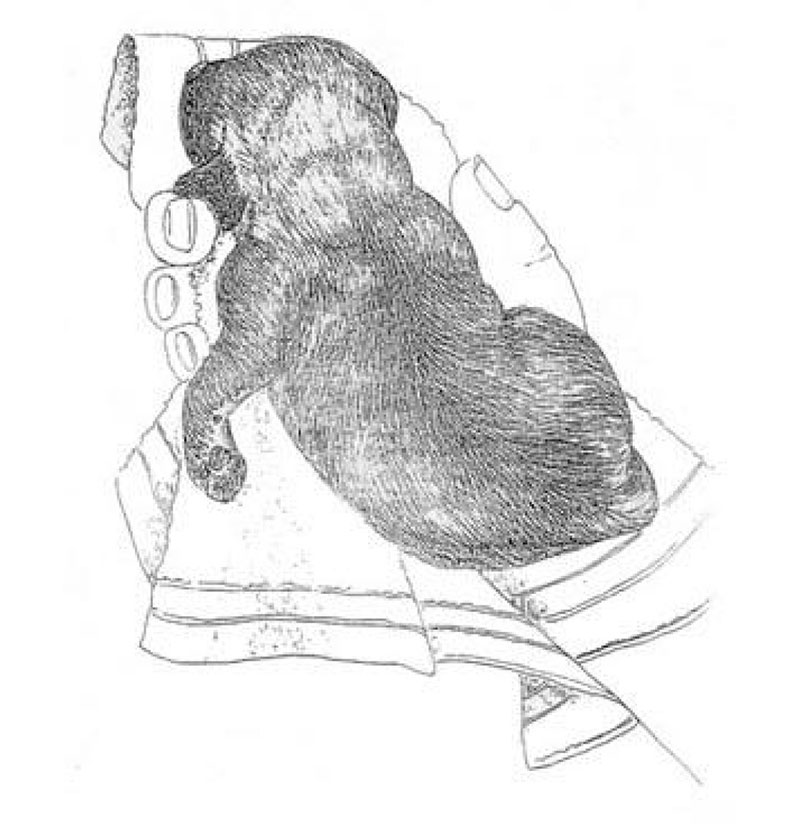
  • Tactical stimulation (between toes)
  • Head held erect
  • Head pointed down
  • Supine position
  • Thermal stimulation
  • Tactile stimulation
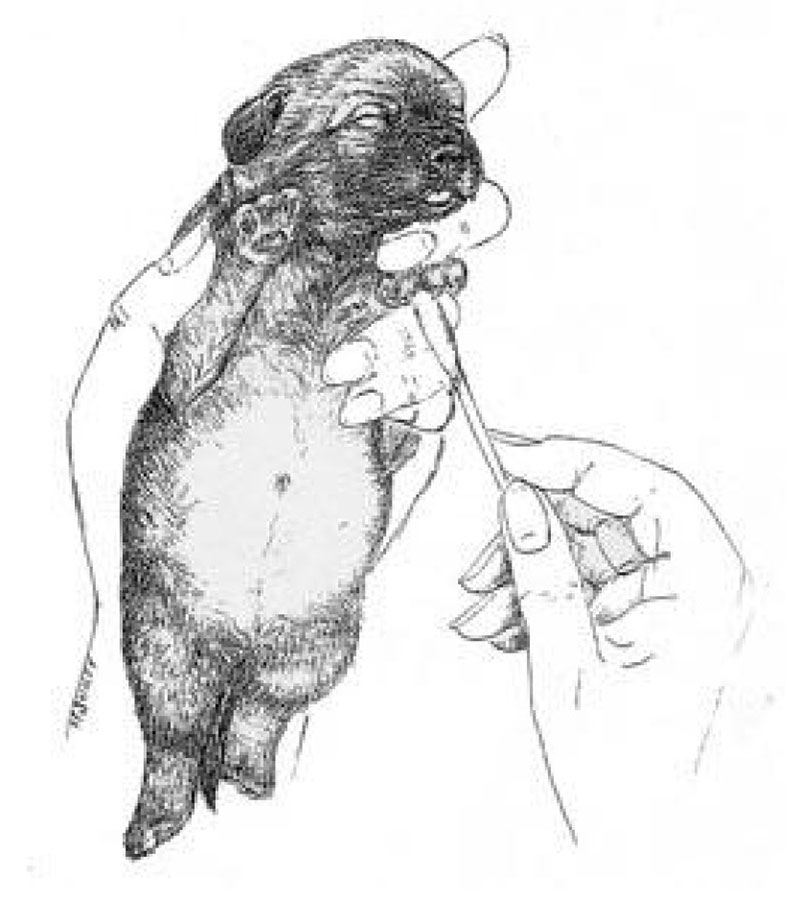
Tactile stimulation - holding the pup in one hand, the handler gently stimulates (tickles) the pup between the toes on any one foot using a Q-tip. It is not necessary to see that the pup is feeling the tickle. Time of stimulation 3 - 5 seconds. (Figure 1)

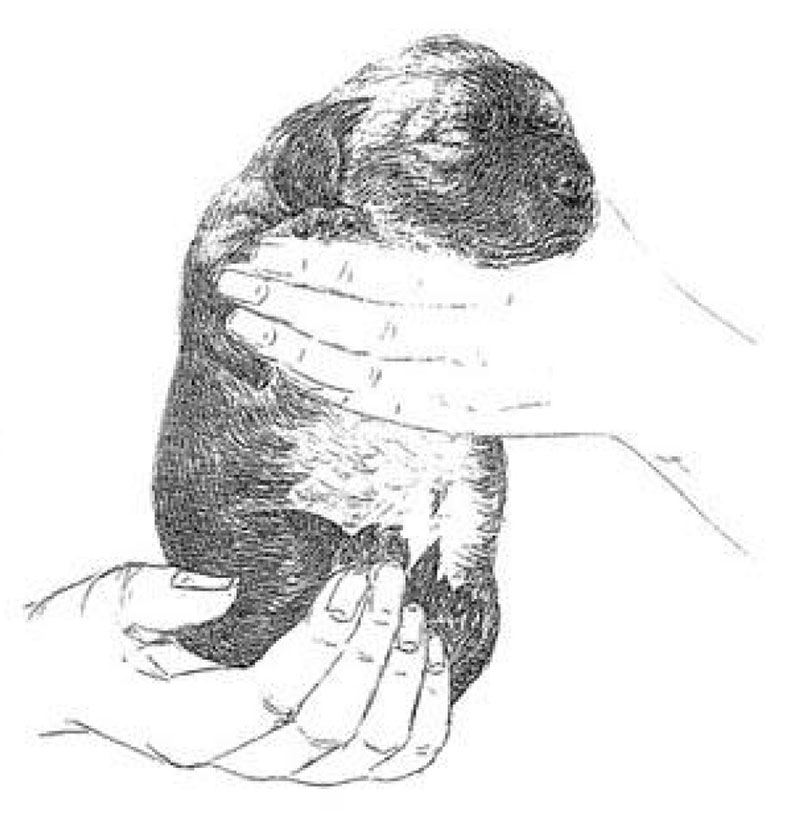
Head held erect - using both hands, the pup is held perpendicular to the ground, (straight up), so that its head is directly above its tail. This is an upwards position. Time of stimulation 3 - 5 seconds. (Figure 2)

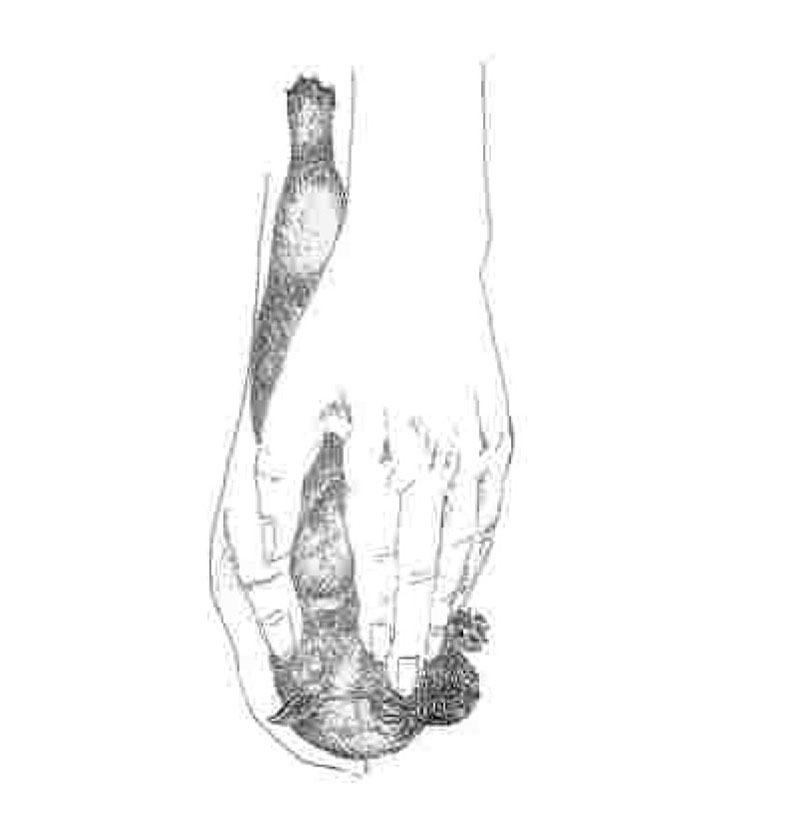
Head pointed down - holding the pup firmly with both hands the head is reversed and is pointed downward so that it is pointing towards the ground. Time of stimulation 3 - 5 seconds. (Figure 3)

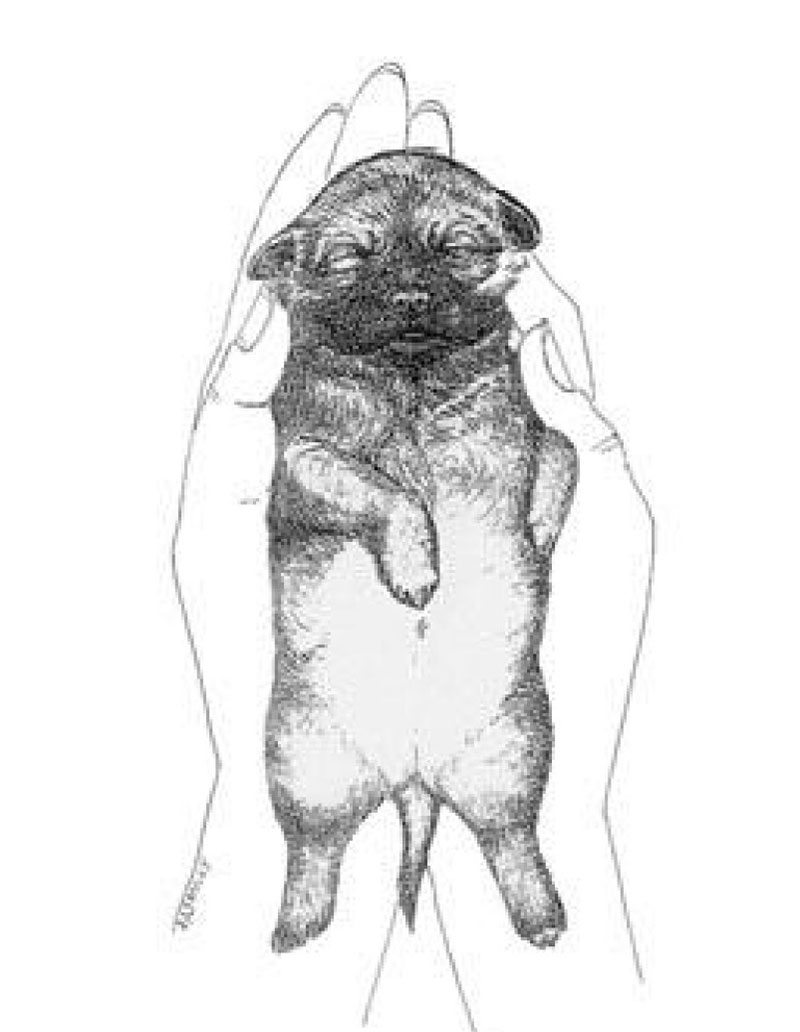
Supine position - hold the pup so that its back is resting in the palm of both hands with its muzzle facing the ceiling. The pup while on its back is allowed to sleep. Time of stimulation 3-5 seconds. (Figure 4)

Thermal stimulation—use a damp towel that has been cooled in a refrigerator for at least five minutes. Place the pup on the towel, feet down. Do not restrain it from moving. Time of stimulation 3-5 seconds. (Figure 5)

These five exercises will produce neurological stimulations, none of which naturally occur during this early period of life. Experience shows that sometimes pups will resist these exercises, others will appear unconcerned. In either case a caution is offered to those who plan to use them. Do not repeat them more than once per day and do not extend the time beyond that recommended for each exercise. Over stimulation of the neurological system can have adverse and detrimental results. These exercises impact the neurological system by kicking it into action earlier than would be normally expected, the result being an increased capacity that later will help to make the difference in its performance. Those who play with their pups and routinely handle them should continue to do so because the neurological exercises are not substitutions for routine handling, play socialization or bonding.

Benefits of Stimulation

Five benefits have been observed in canines that were exposed to the Bio Sensor stimulation exercises. The benefits noted were:

Improved cardio vascular performance (heart rate)
Stronger heart beats
Stronger adrenal glands
More tolerance to stress
Greater resistance to disease

In tests of learning, stimulated pups were found to be more active and were more exploratory than their non- stimulated littermates over which they were dominant in competitive situations.

Secondary effects were also noted regarding test performance. In simple problem solving tests using detours in a maze, the non-stimulated pups became extremely aroused, whined a great deal, and made many errors. Their stimulated littermates were less disturbed or upset by test conditions and when comparisons were made, the stimulated littermates were more calm in the test environment, made fewer errors and gave only an occasional distress sound when stressed.

Figure 1 Tactical stimulation


Figure 2 Head held erect


Figure 3 Head pointed down


Figure 4 Figure Supine position


Figure 5 Thermal stimulation


Link to entire article: https://breedingbetterdogs.com/article/early-neurological-stimulation

The BB's are noisy buggers! ๐Ÿ™‰ NEONATAL PERIOD: Day 1-12


The BB's are very noisy while drinking and scooting around the box, if you're watching the Puppy Culture videos you might have heard a new word:

 "etepimeleticin" - which means the noises and behavior in young animals from their care-seeking adults.

Some other info about the pups development at this stage . . .

NEONATAL PERIOD: DAY 1–DAY 12

For the first two weeks of life, a puppy is considered a neonate. Born with his eyes and ears closed, he enters the world blind, deaf, and neurologically underdeveloped. At this early stage, there is almost no difference in brain activity between the time he is sleeping and the time when he’s awake. Studies have shown that handling and other interaction experienced during the neonatal period can lead to a quicker maturation of the nervous system and an enhanced development of motor and problem-solving skills.

As part of Puppy Culture, we do ENS (to be covered in another post) and start (2) two days after their tails and dew claw removal. The procedure is necessary, but does put stress on the puppies so we want them to recover before moving to the early neurological stimulation processes. 

Saturday, February 1, 2020

One of the most endearing ways your dog shows you trust . . .

Emery and her lobster, she LOVES carrying toys around and bringing them to me/anyone!

One of the most endearing parts of pet ownership is coming home to your dog, who probably waits to greet you at the door. Along with a wagging tail and smile, some dogs also come ready with a toy in their mouth. Carrying around a favorite toy is a pastime many dogs enjoy — for comfort, entertainment or to satisfy their drive for prey — but if your dog brings his toy directly to you, it could be for another reason entirely.

Some dog trainers believe dogs may present you with a favorite toy as a way to as a way to please you — the leader of their social unit. Ages ago, dogs may have offered food or prey to their leaders as an offering of sorts, and your domestic canine buddy may retain some of this primal instinct to offer his toy to you.

Your positive reaction and petting only serves to reinforce the behavior, which is why your dog may present you with a toy virtually every time you come in the front door. Why else might your dog bring you his toys?

Top reasons dogs bring you their toys . . . 

• They’re excited — Your arrival is an exciting time for your dog, especially if you’ve been gone for a few hours. He may race to grab a toy because he has so much energy and excitement, and he needs to expend it somewhere. Chewing a toy is a good outlet for that energy. In fact, if your dog tends to exhibit unwanted behaviors to greet you, such as jumping, barking or licking, offering a toy may distract your dog with an appropriate object to lick and chew. Soon, he may learn to pick up a toy when he hears you coming, stopping the problem entirely.

• You taught them to — When you see your dog, do you reach for a toy to start a game of fetch or tug-of-war? This may have become a routine your dog now expects, so he brings the toy to you to get the game started.

• They’re proud of their toys — Some dogs may arrive with a toy in their mouth and a playful grin, but pull away if you try to grab it. Your dog could be trying to show off his toy or enjoy the game of keep-away that ensues.

• They want to play — One of the simplest reasons why your dog brings you a toy is because he wants you to interact with him, play or attract your attention. When you oblige, you’re confirming that this is a great way to get the attention and playtime he craves. 

• They trust you — When your dog brings you a toy, he’s revealing his trust in you. If he drops it at your feet, consider it a compliment and reward your dog with a smile, a scratch and a game or two.

• They love you — Your dog’s toys may be his most prized possessions. When he offers them to you as the head of his social unit, it’s a sign of affection that reveals his love for you.

• It’s comforting — For some dogs, carrying around a toy is like carrying a security blanket. If your dog is one of those who adores having a toy in his mouth, it may be coincidence that when you walk in the room, and he runs over, he just so happens to have a toy in his mouth too. While herding dogs and
retrievers are most known for their love of carrying around toys, any breed may do it.

Why some dogs hoard toys

An extension of bringing their owners toys is another peculiar behavior: toy hoarding. This again traces back to your dog’s ancestors, who may have hoarded food by burying it in order to come back and eat it if they couldn’t find a meal. Some dogs continue this behavior in the modern day by hiding toys between couch cushions or in laundry baskets (some dogs may also hide away treats, socks or
other items they find around your home). As noted by the American Kennel Club:

“Hoarding behavior in dogs is an instinctive behavior that originated during the time when their ancestors did not have regular meals appear magically, at least twice a day. They were lucky if they ate every few days, and if there was a jackpot of more food than could be eaten at once, these dog ancestors would sometimes take some food and bury it in a safe place for later.”

If your dog hoards toys here and there, there’s no need to worry, but if the behavior turns obsessive or he starts to aggressively guard his stash, you’ll need to intervene. You may be able to curb the behavior just by putting out one or two toys at a time. You can also consult with a veterinary behaviorist to help you determine what's causing your pet's behavior and how best to handle it.

As far as bringing you toys is concerned, however, this is a natural behavior that many dogs — and their owners — enjoy, and there’s no need to stop it 

Takeaways: 

  • Some dog trainers believe dogs may present you with a favorite toy as a way to please you — the leader of their social unit
  • A dog may race to grab a toy because he’s got so much energy and excitement, and he needs to expend it somewhere
  • One of the simplest reasons why your dog brings you a toy is because he wants you to interact with him, play or attract your attention
  • When your dog brings you a toy, he’s revealing his trust in you
  • If your dog drops a toy at your feet, consider it a compliment and reward your dog with a smile, a scratch and a game or two

Source: Dr. Karen Becker @ Healthy Pets.com

Our first pawticure ๐Ÿ’…๐Ÿผ

Vizslas are a relatively easy (wash and wear) breed, and the only regular grooming needed is nails and teeth. NAILS SHOULD BE DONE WEEKLY.

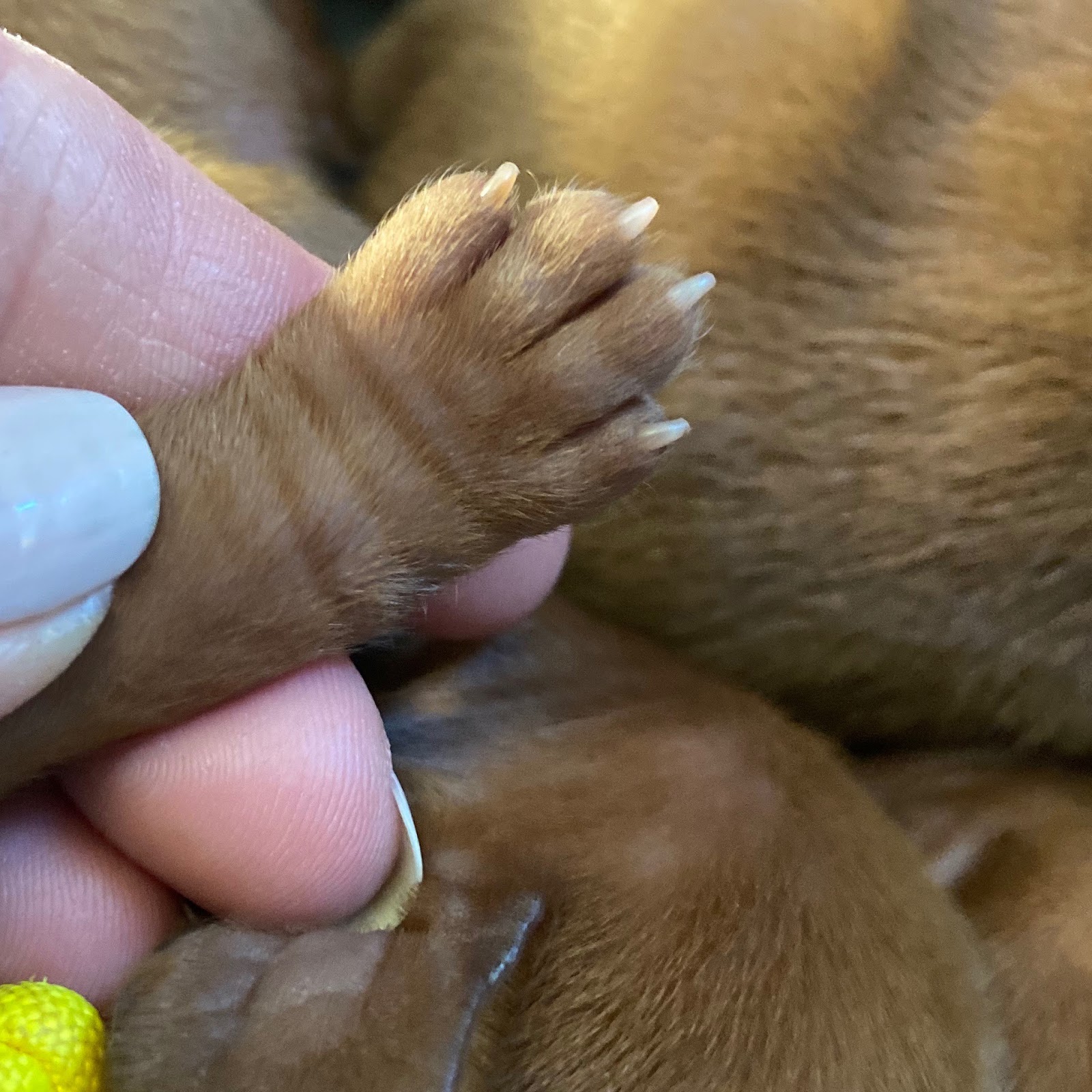
The BB's had their first nail trim today (Day 4) and will have them done every 3 days thereafter. You would not believe how long the nails get and if left untrimmed they can scratch one another in the eye or tear up mom's nipples and teats.


Brixton/Yellow Boy and his fresh pedi! 

You can see how sharp/long they are only after a few days old - wow!

At two weeks old the puppies are started on the dremel (on low speed). It is so much faster and easier than clipping! I use a cordless and lighted version for pups and adults, you can get it on Amazon.


Pups will be acclimated to the Dremel by the time they go home and the owner is required on puppy "Go Home Day" to demonstrate their ability to trim the nails (and bring their Dremel!).  This is a weekly requirement for each Moonlight Vizsla Puppy owner. 

Three year old "Cordie" and her "perfect pedi"

NOTE:  If you can hear your dog's nails on the floor, they are already too long!